
Every year, millions of people start a new diet with genuine hope. They count calories, cut carbs, avoid fat, skip meals, or follow rigid rules that promise fast results. For a few weeks, the scale moves. Motivation feels high. Then something breaks—energy drops, hunger increases, and old habits quietly return.
What follows is not failure of willpower, but failure of the system itself.
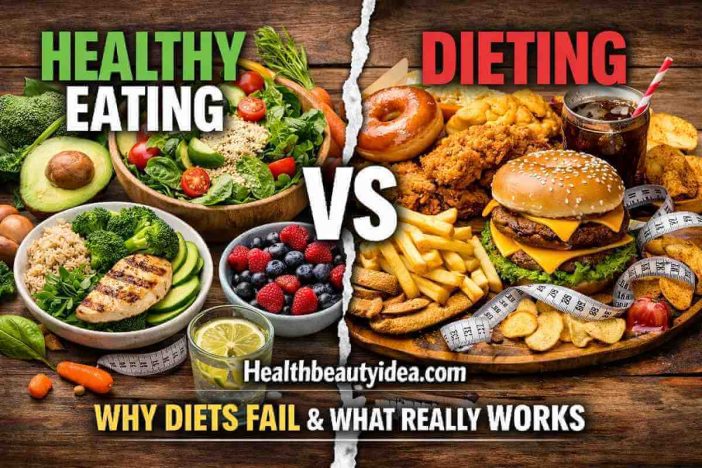
This is where the confusion between healthy eating vs dieting becomes costly. One is designed for short-term compliance. The other is designed for long-term living. Understanding the difference is not just helpful—it is essential if you want results that last.
Healthy Eating vs Dieting: What’s the Real Difference?
At a glance, dieting and healthy eating may look similar. Both involve food choices. Both claim to support weight loss. But structurally, they are built on very different foundations.
Dieting is typically:
- Temporary
- Rule-based
- Outcome-driven (usually weight loss)
- Restrictive by design
Healthy eating, by contrast, is:
- Long-term
- System-based
- Behavior-driven
- Flexible and adaptive
Dieting asks, “What should I stop eating?”
Healthy eating asks, “How does my body actually work, and how do I support it consistently?”
That distinction explains why most diets fail—not immediately, but eventually.
Why Most Diets Fail (Even When People Try Hard)
Diets Are Built for Compliance, Not Sustainability
Most popular diets rely on strict rules: eat this, avoid that, follow the plan exactly. While structure can help short term, it rarely survives real life—social events, stress, travel, illness, or emotional fatigue.
When the rules break, the diet collapses.
This pattern is explored further in Why Is It Difficult to Lose Weight? Discover the Hidden Reasons and Solutions!, which explains how metabolic adaptation, hormones, and psychology undermine rigid approaches over time.
Calorie Restriction Triggers Biological Pushback
Aggressive dieting often leads to:
- Increased hunger hormones (ghrelin)
- Reduced satiety signals (leptin)
- Slower resting metabolism
- Loss of lean muscle mass
The body doesn’t interpret extreme dieting as “health”—it interprets it as threat.
This is why many people regain weight after dieting, sometimes gaining more than they lost.
Dieting Ignores Context: Stress, Sleep, and Daily Routines
Most diets focus narrowly on food, ignoring factors that strongly influence appetite and weight regulation:
- Chronic stress
- Poor sleep quality
- Disrupted daily routines
When these factors are misaligned—especially sleep timing and circadian rhythm—diet adherence becomes harder regardless of motivation.
What Healthy Eating Does Differently (And Why It Works)
Healthy Eating Is a System, Not a Phase
Healthy eating is not about perfect meals. It is about repeatable patterns that fit real life.
This system-based approach is fully explained in Healthy Eating Explained: The Evidence-Based Guide to Building a Balanced Diet for Life, which outlines how nutrition, metabolism, and habits interact over time.
Instead of rigid rules, healthy eating emphasizes:
- Food quality
- Portion awareness
- Nutrient adequacy
- Consistency over perfection
Focus on Nourishment, Not Deprivation
Dieting often leads with restriction. Healthy eating leads with nourishment.
When the body receives adequate protein, fiber, micronutrients, and energy:
- Hunger stabilizes
- Cravings reduce
- Energy improves
- Adherence becomes easier
This is why people eating balanced, nutrient-dense meals often lose weight without feeling like they are “on a diet.”
Healthy Eating Supports Long-Term Weight Regulation
Weight management is not just about losing weight—it’s about keeping it off.
Healthy eating supports:
- Lean muscle preservation
- Stable blood sugar
- Hormonal balance
- Improved relationship with food
These are not side benefits. They are the foundation of sustainable results.
Healthy Eating vs Dieting for Weight Loss: What Science Shows
Large-scale nutrition research consistently shows:
- Short-term weight loss can occur with many diets
- Long-term success correlates with dietary quality, not strict rules
- Consistency matters more than macronutrient ratios
Studies summarized by institutions like Harvard Health Publishing consistently emphasize whole foods, balanced patterns, and sustainability over elimination-based diets.
This aligns with findings discussed in Diet vs Exercise: Which Matters More for Sustainable Weight Loss?, where diet quality—not extreme restriction—drives results.
Common Dieting Myths That Keep People Stuck
“If It’s Hard, It Must Be Working”
Difficulty is not a marker of effectiveness. Sustainable habits often feel surprisingly boring—but boring is repeatable.
“Cheat Meals Ruin Progress”
This mindset reinforces guilt. Healthy eating allows flexibility without moral judgment around food.
“Discipline Is the Problem”
Most people don’t lack discipline—they lack a system that works under pressure.
Practical Tips: Transitioning from Dieting to Healthy Eating
1. Stop Labeling Foods as “Good” or “Bad”
Focus on frequency, not perfection.
2. Build Meals Around Protein First
This improves satiety and muscle preservation.
3. Use Simple Structures
Tools like the plate method reduce decision fatigue without tracking.
4. Align Eating With Daily Rhythms
Meal timing and sleep patterns—regulated by circadian rhythm—affect appetite and energy more than most people realize.
Frequently Asked Questions
Is dieting ever useful?
Short-term dietary structure can help reset habits, but it should transition into a sustainable eating system.
Can you lose weight without dieting?
Yes. Many people lose weight through healthy eating patterns without following a formal diet.
What works best long term?
Balanced nutrition, consistency, adequate sleep, and stress regulation—not restriction.
Final Thoughts: Why Healthy Eating Wins Long Term
The debate between healthy eating vs dieting often misses the real issue. Diets are designed to end. Healthy eating is designed to continue.
If you want results that last beyond motivation, beyond short-term goals, and beyond the next “new plan,” the answer is not another diet. It’s a system you can live with.
Healthy eating doesn’t promise fast results. It delivers lasting ones.



 Skincare Solutions & Skin Health
 Mental Health, Stress & Emotional Wellbeing
 Sleep, Energy & Daily Performance