
What Is the Difference Between Brown Fat and White Fat?
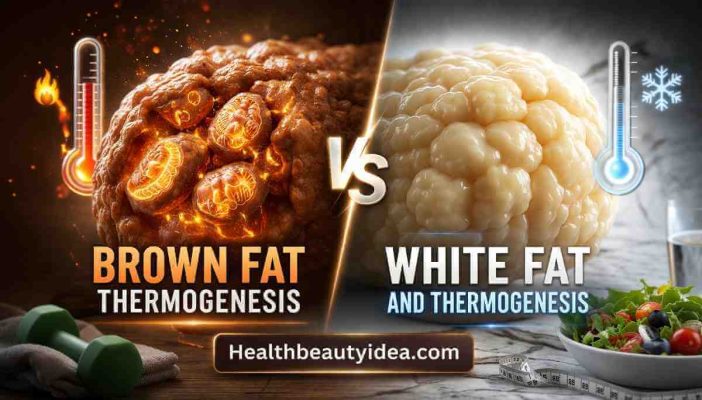
Brown fat burns calories to produce heat (thermogenesis), while white fat stores energy for future use. The balance between these fat types influences metabolism, fat loss efficiency, and long-term weight regulation.
Why Not All Body Fat Is the Same
Fat is not a passive tissue.
It is metabolically active and hormonally involved.
There are three main types:
- White adipose tissue (WAT)
- Brown adipose tissue (BAT)
- Beige fat (convertible form)
Each plays a different role in energy balance and thermogenesis.
White Fat: The Energy Storage System
White fat is the most abundant fat type in the body.
Its functions include:
- Storing excess calories
- Protecting organs
- Producing hormones (including leptin)
However, excessive white fat—especially visceral fat—can:
- Increase inflammation
- Impair insulin sensitivity
- Promote fat storage
This is explained deeper in Visceral Fat vs Subcutaneous Fat.
White fat is not “bad”—but excess is metabolically costly.
Brown Fat: The Calorie-Burning Tissue
Brown fat behaves differently.
Instead of storing energy, it burns it.
Its primary function:
Heat production through thermogenesis
Brown fat contains:
- More mitochondria
- Higher metabolic activity
- Uncoupling protein 1 (UCP1)
This allows it to convert calories directly into heat.
What Is Thermogenesis?
Thermogenesis is the process by which the body produces heat by burning calories.
There are three types:
- Basal thermogenesis (basic metabolic activity)
- Diet-induced thermogenesis
- Adaptive thermogenesis
Adaptive thermogenesis is explored in Adaptive Thermogenesis: Why Dieting Gets Harder Over Time.
Brown fat is a key driver of thermogenic energy expenditure.
Beige Fat: The Hybrid System
Beige fat is a flexible fat type.
It can behave like:
- White fat (storage)
- Brown fat (burning)
Under certain conditions, white fat cells can convert into beige fat.
This process is called:
“Browning”
This is a major target in metabolic research.
How Brown Fat Influences Weight Loss
Higher brown fat activity is associated with:
- Increased calorie expenditure
- Improved glucose metabolism
- Better insulin sensitivity
People with more active brown fat may:
- Burn more calories at rest
- Resist weight gain more effectively
However, brown fat alone does not override calorie balance.
It enhances efficiency—not replaces discipline.
Why Most Adults Have Less Active Brown Fat
Brown fat is more active in:
- Infants
- Lean individuals
- Cold-adapted populations
Modern lifestyle reduces its activity due to:
- Constant thermal comfort
- Sedentary behavior
- High-calorie diets
This contributes to reduced metabolic flexibility.
See Metabolic Flexibility for how fuel usage adapts over time.
How to Activate Brown Fat Naturally
Cold Exposure
Cold exposure is the most researched trigger.
Examples:
- Cold showers
- Cooler environments
- Outdoor exposure
Cold stimulates brown fat activation through norepinephrine release.
Physical Activity
Exercise indirectly promotes:
- Browning of white fat
- Improved mitochondrial function
This aligns with NEAT and Daily Fat Burning.
Movement supports metabolic activity beyond structured workouts.
Nutritional Factors
Certain nutrients may support thermogenesis:
- Capsaicin (spicy foods)
- Green tea catechins
- Protein intake
However, effects are modest—not transformative alone.
Sleep and Circadian Rhythm
Circadian rhythm regulates metabolic processes.
Disrupted sleep may reduce thermogenic efficiency.
See Circadian Rhythm for deeper hormonal and metabolic timing.
The Link Between Brown Fat and Hormones
Hormonal systems influence fat behavior.
For example:
- Leptin interacts with energy expenditure
- Insulin influences fat storage
- Thyroid hormones regulate thermogenesis
Leptin dysfunction, explained in Leptin Resistance and Fat Loss Resistance, may impair energy balance signaling.
Brown Fat vs White Fat (Comparison Table)
| Feature | Brown Fat | White Fat |
|---|---|---|
| Function | Burns calories | Stores energy |
| Mitochondria | High | Low |
| Color | Brown (iron-rich) | Pale |
| Role in metabolism | Increases energy expenditure | Stores excess calories |
| Thermogenesis | Active | Minimal |
Common Misconceptions About Fat Burning
“All fat is bad”
False. Brown fat is metabolically beneficial.
“You can turn all fat into brown fat”
Not entirely. But some white fat can become beige fat under the right conditions.
“Thermogenesis replaces diet”
No. It enhances calorie expenditure but does not override calorie balance.
Expert Insight: Why Some People Burn Calories More Easily
In practice, individuals with:
- Higher lean mass
- Better mitochondrial efficiency
- More active brown fat
often experience:
- Easier fat loss
- Higher baseline energy expenditure
But these advantages are influenced by lifestyle—not fixed destiny.
FAQ (People Also Ask)
Can brown fat help you lose weight?
It contributes to calorie burning but must be combined with diet and lifestyle changes.
How do I know if I have brown fat?
Everyone has some brown fat, but activity levels vary and are not easily measured outside clinical settings.
Does cold exposure burn fat?
Cold exposure can activate brown fat, increasing energy expenditure slightly.
Is brown fat activation safe?
Moderate exposure (like cool environments) is generally safe, but extreme cold should be avoided.
Reference
- Harvard Medical School (metabolism and adipose tissue research)
- National Institutes of Health (brown fat thermogenesis studies)
Bottom Line
Brown fat vs white fat and thermogenesis reveal a deeper truth about fat loss:
Your body is not just storing energy—it is regulating it.
White fat stores.
Brown fat burns.
Beige fat adapts.
Fat loss success depends not only on calorie balance, but on:
- Hormonal signaling
- Metabolic flexibility
- Inflammation control
- Thermogenic activity
The goal is not to eliminate fat—
but to improve how your body uses it.
When thermogenesis improves and metabolic systems stabilize, fat loss becomes more efficient, more sustainable, and less resistant.



 Skincare Solutions & Skin Health
 Mental Health, Stress & Emotional Wellbeing
 Sleep, Energy & Daily Performance