
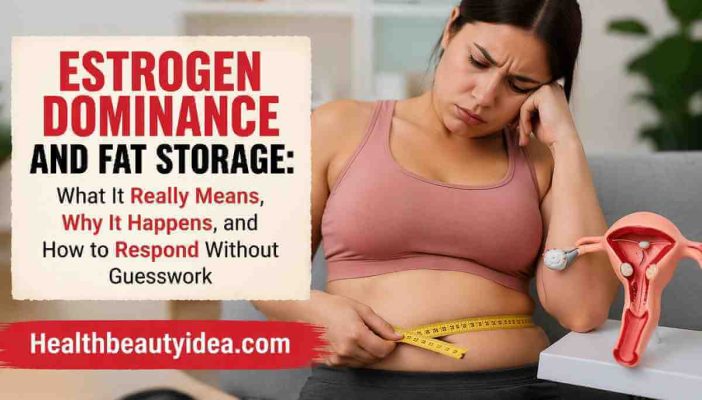
The phrase usually appears after something changes fast enough to feel personal. Clothes fit differently. Midsection fullness shows up where it did not before. Water retention starts to blur the line between bloating and fat gain. Weight loss strategies that once worked become less reliable.
That is why the search for estrogen dominance and fat storage has grown: people are trying to name a pattern.
The problem is that the term is often used loosely online. In mainstream medical guidance, clinicians more commonly discuss changing estrogen and progesterone levels, especially during perimenopause and menopause, rather than treating “estrogen dominance” as a formal standalone diagnosis. That does not make the symptoms imaginary. It means the biology needs to be described more carefully. Women’s Health.gov explains that during perimenopause and menopause, estrogen and progesterone levels change substantially, and lower estrogen is linked to shifts in weight, metabolism, and body fat distribution.
Estrogen Dominance and Fat Storage: The Quick Answer
What many people call “estrogen dominance” usually refers to a state in which estrogen’s effects are relatively high compared with progesterone or compared with the body’s current metabolic context. That may influence fluid retention, appetite, fat distribution, and insulin sensitivity, but it does not mean estrogen alone is the sole cause of weight gain. Estrogen biology is tightly connected to adipose tissue, inflammation, and energy regulation.
What Estrogen Actually Does in Metabolism
Estrogen is not just a reproductive hormone. It helps regulate:
- fat distribution
- insulin sensitivity
- appetite signaling
- inflammation
- energy balance
Research reviews from NIH-linked sources show that estrogen plays a meaningful role in adipose tissue function and metabolic health. Estrogen deficiency is associated with more central fat accumulation and metabolic dysfunction, while adipose tissue itself also participates in estrogen metabolism. In other words, the relationship goes in both directions: hormones affect fat, and fat tissue affects hormone activity.
Why the Phrase “Estrogen Dominance” Gets Confusing
The phrase becomes misleading when it is treated like a one-word explanation for every symptom.
Here is the more accurate frame:
| What People Often Mean | What Is Usually Happening Biologically |
|---|---|
| “My estrogen is too high” | Estrogen may be fluctuating, relatively high compared with progesterone, or being interpreted without context |
| “I suddenly gained hormonal fat” | Hormone shifts may be changing fat distribution, appetite, water retention, or insulin sensitivity |
| “My body feels puffy and soft” | Fluid retention, inflammatory load, menstrual-cycle shifts, or reduced progesterone may be part of the picture |
| “Nothing works anymore” | Hormonal shifts may be overlapping with sleep disruption, stress, lower muscle mass, or metabolic adaptation |
That distinction matters because it changes the solution. If the real driver is poor sleep, chronic stress, insulin resistance, or menopausal hormone transition, treating it as a vague “estrogen problem” delays useful action.
When Estrogen Seems to Promote Fat Storage
During Perimenopause, the Ratio Can Feel Different Even Before Estrogen Falls Low
Perimenopause is not a clean straight line downward. Hormone levels fluctuate. Some cycles can produce unpredictable estrogen and progesterone patterns before menopause is reached. Women’s Health.gov notes that during the transition, ovaries make changing amounts of estrogen and progesterone, which is why symptoms can feel inconsistent and surprising.
In Obesity, Adipose Tissue Can Contribute to Estrogen Production
Adipose tissue is not passive storage. Reviews in NIH-linked literature note that fat tissue can contribute to estrogen production and metabolism, which helps explain why the relationship between body fat and estrogen status is bidirectional. More fat can change estrogen handling, and altered estrogen biology can affect where fat accumulates.
Estrogen Changes Can Shift Fat Distribution
One of the most clinically relevant effects of estrogen change is where fat gets stored. Lower estrogen, especially around menopause, is associated with greater abdominal and visceral fat accumulation compared with the more classic lower-body pattern seen earlier in life. That is one reason belly fat often feels more “hormonal” in midlife.
The Difference Between Fat Storage and Water Retention
This is where many readers get misled.
Estrogen-related shifts can affect fluid balance as well as fat distribution. If someone feels suddenly heavier, softer, or more bloated, the change is not always pure fat tissue. Some of it may be water retention. That is especially relevant when symptoms fluctuate across the menstrual cycle or during perimenopause.
This is why a woman who believes she has “estrogen fat” may actually be seeing a mix of:
- water retention
- abdominal distension
- bowel changes
- inflammatory puffiness
- true fat gain over time
That is exactly why the distinction in Water Retention vs Fat Gain: How to Tell the Difference matters here. It helps readers separate fast changes from slow ones.
Estrogen, Progesterone, and the Relative Balance Problem
The popular use of “estrogen dominance” often points to one practical reality: progesterone may be lower relative to estrogenic effect.
That relative imbalance may matter because progesterone and estrogen do not create the same metabolic and symptom profile. Women’s Health.gov notes that both hormones change during the menopause transition, and symptom clusters can reflect the shift rather than a single isolated hormone problem.
That makes this a pattern-recognition issue, not a slogan.
How Estrogen-Related Shifts May Affect Belly Fat
Insulin Sensitivity Can Change
Estrogen interacts with glucose and adipose tissue regulation. Reviews on estrogen and adipose physiology describe links between estrogen signaling, glucose metabolism, and obesity-related dysfunction. When that system becomes less efficient, the body may become more likely to store energy centrally.
Visceral Fat Risk Can Rise
This is where the topic connects directly to Visceral Fat vs Subcutaneous Fat. Hormone shifts can push fat storage toward the abdominal region, and that change matters because visceral fat is metabolically more harmful than subcutaneous fat.
H3: Appetite and Food Choices Can Shift
Hormonal changes do not only change fat cells. They can also change appetite, cravings, stress resilience, and body perception. The Office on Women’s Health notes that midlife hormonal changes can affect appetite, weight, metabolism, and body image.
The Role of Stress in “Hormonal” Fat Storage
A lot of so-called estrogen-dominance weight gain is not estrogen alone. It is estrogen changes colliding with:
- chronic stress
- poor sleep
- higher cortisol
- lower activity
- more insulin resistance
Once that happens, the body is far more likely to store fat centrally. That is why Cortisol and Belly Fat: The Stress–Abdomen Connection belongs inside this conversation, not outside it.
The Menopause Connection
This topic becomes especially important in midlife because menopause changes the whole hormonal environment. Office on Women’s Health states that lower estrogen may play a role in weight gain after menopause, but it also points out that slower metabolism with age, lower activity, and muscle loss all contribute. ACOG also notes that hormone therapy can affect where fat is stored, but by itself it is not a weight-loss treatment.
That is the clinically honest answer:
- yes, estrogen changes matter
- no, the entire story is not “too much estrogen”
- no, one hormone fix does not automatically solve body composition
What Usually Helps More Than Guessing
H3: Improve Blood Sugar Stability
If insulin is high and meals are poorly structured, fat storage becomes easier. This is why Insulin Resistance and Weight Loss Plateaus should sit next to this article in the silo.
Increase Protein and Fiber
Protein supports satiety and muscle. Fiber supports gut microbiome stability, glucose control, and satiety. Those are two of the most practical levers when hormones are making appetite and body composition feel less predictable.
Protect Sleep
Sleep disruption worsens appetite regulation, stress response, and body-fat distribution. If hormones already feel unstable, poor sleep magnifies the problem.
Strength Train, Don’t Just Diet Harder
Muscle mass improves insulin sensitivity and metabolic stability. For women experiencing body-composition change, that matters more than chasing endless calorie cuts.
Stop Treating Every Symptom as a Supplement Problem
Because this is a YMYL topic, the careful move is to say this plainly: if symptoms are persistent, irregular, or severe, medical evaluation is better than self-diagnosing from social media language.
Common Mistakes
Calling Every Midsection Change “Estrogen Dominance”
Sometimes it is visceral fat, sometimes water retention, sometimes stress physiology, sometimes menopausal redistribution, sometimes a combination.
Using Symptom Lists as a Diagnosis
The overlap between hormone changes, PMS, perimenopause, sleep deprivation, and stress is too large for self-certainty.
Chasing Hormone “Balance” With Random Supplements
That often adds cost and confusion without improving the real drivers.
Ignoring Body Composition and Only Watching the Scale
Hormonal fat storage issues often show up in where weight is carried, not just how much weight exists.
Practical Framework: What to Do If You Suspect Hormone-Related Fat Storage
- Track the pattern
✅ cycle-related?|
✅ stress-related?
✅ sleep-related?
✅ menopause-related? - Separate fast from slow
✅ overnight = usually water
✅ multi-week trend = more likely fat gain - Check the metabolic basics
✅ protein
✅ fiber
✅ sleep
✅ movement
✅ stress load - Look for clustering symptoms
✅ irregular cycles
✅ mood shifts
✅ sleep disruption
✅ abdominal gain
✅ fluid retention - Seek clinical evaluation when the pattern is persistent
✅ especially if bleeding changes, severe symptoms, or menopause transition issues are involved
FAQ
Is estrogen dominance a real medical diagnosis?
Not usually as a formal standalone diagnosis in mainstream guidance. It is more often used informally to describe symptoms or relative hormone imbalance patterns, especially when estrogenic effects seem high relative to progesterone or current life stage
Can estrogen cause belly fat?
Estrogen changes can influence where fat is stored. In midlife and menopause, lower estrogen is associated with a shift toward more abdominal and visceral fat storage.
Can fat tissue increase estrogen activity?
Yes. Adipose tissue participates in estrogen production and metabolism, which is one reason the relationship between obesity and estrogen biology is bidirectional.
What helps most if hormones seem to be affecting weight?
Usually not one dramatic fix. The strongest foundation is better blood sugar control, enough protein and fiber, improved sleep, reduced stress load, and resistance training—plus medical assessment if symptoms suggest a true endocrine or menopausal transition issue.
What to Do Next
If the phrase estrogen dominance and fat storage describes your experience, the next move is not panic and not guesswork.
Start with this order:
- identify whether the change is fat, water, or both
- assess whether the pattern is linked to cycle changes, perimenopause, or persistent symptoms
- rebuild the basics: protein, fiber, sleep, strength training, stress control
- investigate medical causes when symptoms are strong, persistent, or disruptive
The body is rarely acting at random. It is responding to signals.
The more accurately you identify those signals, the less likely you are to waste months fighting the wrong problem.


 Skincare Solutions & Skin Health
 Mental Health, Stress & Emotional Wellbeing
 Sleep, Energy & Daily Performance