
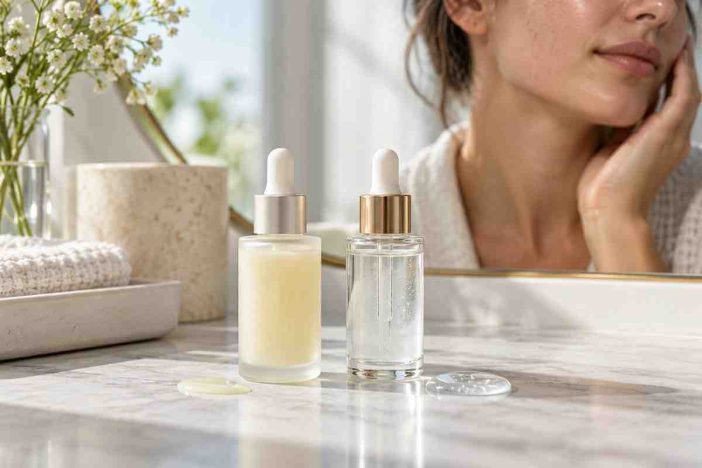
Azelaic acid vs niacinamide can feel like an impossible skincare decision when both bottles seem to promise the same things: fewer breakouts, calmer redness, faded dark marks, smoother texture, and more even-looking skin.
That overlap is real—but incomplete.
Imagine two people standing at the same skincare shelf. One is dealing with inflamed bumps and the brown marks that remain after every breakout. The other has oily but easily irritated skin that becomes tight whenever stronger acne treatments are added. Both could benefit from one of these ingredients. They may not benefit from them for the same reason.
That distinction matters.
Azelaic acid behaves more like a targeted corrective active, with particularly useful evidence for acne, post-inflammatory pigmentation, and papulopustular rosacea. Niacinamide behaves more like a versatile support ingredient, helping the skin barrier, sebum balance, inflammation, and uneven pigmentation through different mechanisms.
And for many people, the best answer is not azelaic acid or niacinamide.
It may eventually be both.
Quick Answer: Azelaic Acid vs Niacinamide
Choose azelaic acid first when your main concern is:
- inflammatory acne;
- post-acne dark marks;
- acne plus hyperpigmentation;
- papules or pustules associated with rosacea;
- or persistent uneven pigmentation where a more targeted active is appropriate.
Choose niacinamide first when your priority is:
- oily or shiny skin;
- barrier support;
- mild redness or irritation;
- improving tolerance within a larger skincare routine;
- or gradual improvement in uneven tone.
Use both when your skin has overlapping concerns—for example, acne plus post-acne marks plus an easily disrupted barrier—provided your skin tolerates the routine.
The most important point is that these ingredients are complementary, not interchangeable.
If redness and dark marks are your main concern, our dedicated guide to azelaic acid for rosacea and dark spots explains the ingredient in greater depth.
Azelaic Acid vs Niacinamide at a Glance
| Question | Azelaic Acid | Niacinamide |
|---|---|---|
| Ingredient type | Dicarboxylic acid | Form of vitamin B3 |
| Strongest role | Targeted corrective active | Barrier and oil-balancing support |
| Acne | Stronger clinical role | Supportive role |
| Post-acne marks | Strong option | Can help gradually |
| Rosacea papules/pustules | Established medical use | Mainly supportive barrier role |
| Oily skin | May indirectly help acne-prone skin | Better established for sebum control |
| Skin barrier | Not its primary role | Major strength |
| Hyperpigmentation | Targets abnormal pigmentation pathways | Reduces transfer of pigment to skin cells |
| Irritation potential | Can sting or burn initially | Usually well tolerated, formulation dependent |
| Can they be combined? | Yes, if tolerated | Yes, if tolerated |
| Best first choice | Depends on dominant problem | Depends on dominant problem |
1. They Work Through Different Biological Pathways
The easiest way to understand the difference is to stop thinking about product claims and look at what each ingredient actually does.
What azelaic acid does
Azelaic acid is a naturally occurring dicarboxylic acid with anti-inflammatory, antimicrobial, anti-keratinizing, and pigmentation-modulating properties.
In dermatology, it has been studied for:
- acne vulgaris;
- papulopustular rosacea;
- post-inflammatory hyperpigmentation;
- and melasma.
Its effects are useful because acne and pigmentation frequently occur together.
Someone may clear a pimple in a week or two, only to be left with a brown or gray-brown mark that persists for months.
Azelaic acid can address both sides of that cycle: the inflammatory lesion and the pigmentation that may follow it.
What niacinamide does
Niacinamide, also called nicotinamide, is a form of vitamin B3.
Its skincare roles include:
- supporting epidermal barrier function;
- decreasing transepidermal water loss;
- modulating inflammatory responses;
- reducing facial sebum in some studies;
- and improving the appearance of hyperpigmentation.
One mechanism behind its pigmentation benefits is particularly interesting.
Niacinamide does not primarily work by shutting down tyrosinase in the same way certain pigmentation treatments do. Research indicates that it can reduce the transfer of melanosomes from melanocytes to keratinocytes.
In simple terms, azelaic acid and niacinamide can influence uneven pigmentation at different points in the process.
That helps explain why combining them is biologically reasonable rather than redundant.
2. For Active Acne, Azelaic Acid Has the Stronger Treatment Role
If the question is:
“Which one should I choose for active acne?”
Azelaic acid generally has the clearer treatment-level evidence.
The American Academy of Dermatology describes azelaic acid as an acne treatment that can help unclog pores, act against acne-associated bacteria, reduce inflammation, and improve dark spots that remain after acne resolves.
Systematic reviews have also found that azelaic acid improves acne severity compared with vehicle formulations.
Niacinamide is not useless for acne.
Far from it.
Its anti-inflammatory properties and potential effect on sebum production may make it valuable for acne-prone skin, especially when excessive oil and barrier irritation are part of the picture.
But those roles are different.
Think of the distinction this way
If you have:
active inflammatory lesions + post-acne marks
azelaic acid may deserve priority.
If you have:
oily skin + mild breakouts + irritation from stronger actives
niacinamide may be an excellent supporting ingredient.
And if you have significant, persistent, cystic, nodular, or scarring acne, neither comparison should delay professional treatment.
Skincare products cannot substitute for appropriate medical management of severe acne.
3. For Redness and Rosacea, Do Not Treat the Two Ingredients as Equivalent
This is one of the most important differences.
Azelaic acid has a recognized medical role in papulopustular rosacea, particularly the acne-like bumps and pustules that can accompany the condition.
The American Academy of Dermatology lists topical azelaic acid among FDA-approved treatments for acne-like rosacea breakouts.
That does not mean azelaic acid cures every form of rosacea.
Rosacea can involve:
- persistent facial color change;
- flushing;
- visible blood vessels;
- papules and pustules;
- eye involvement;
- burning or stinging;
- and, in some people, thickening skin.
Different features require different strategies.
Niacinamide occupies another position.
It may help support barrier function in redness-prone or rosacea-prone skin, and niacinamide-containing moisturizers have been studied for improving barrier-related tolerance.
But that is not the same thing as saying niacinamide is a treatment equivalent to prescription-strength azelaic acid for papulopustular rosacea.
Practical decision
If your concern is occasional sensitivity or mild redness associated with a stressed barrier:
niacinamide may be the gentler starting point.
If you have diagnosed rosacea with inflammatory papules or pustules:
azelaic acid has the more direct therapeutic role, although treatment should be matched to the form and severity of rosacea.
Persistent facial redness that you have never had diagnosed deserves more caution than simply buying another serum. Acne and rosacea can look similar, and the wrong self-treatment can complicate sensitive skin.
4. For Dark Spots, Both Can Help—but They Attack Pigmentation Differently
This is where azelaic acid vs niacinamide becomes much more interesting.
Both ingredients appear in routines for uneven pigmentation.
But their mechanisms are not identical.
Azelaic acid and pigmentation
Azelaic acid has antimelanogenic activity and is particularly useful when pigmentation follows inflammation.
That makes it attractive for people who experience the frustrating cycle of:
breakout → inflammation → dark mark → another breakout
A randomized trial has shown improvement in post-inflammatory hyperpigmentation with topical azelaic acid, and systematic reviews support its role in hyperpigmentary conditions including melasma.
Niacinamide and pigmentation
Niacinamide can reduce visible pigmentation by interfering with melanosome transfer between pigment-producing melanocytes and surrounding keratinocytes.
Clinical studies have documented improvement in hyperpigmentation with topical niacinamide formulations.
That creates an important distinction:
azelaic acid can act on abnormal pigmentation production pathways, while niacinamide can influence the movement of pigment into surrounding skin cells.
This does not prove that stacking them automatically doubles results.
But it helps explain why they are not redundant.
What about sunscreen?
No pigmentation routine should rely on brightening ingredients while ignoring UV exposure.
If you are treating post-inflammatory hyperpigmentation, melasma, or uneven tone, consistent broad-spectrum sun protection remains fundamental.
Otherwise, you may spend months trying to fade pigmentation while simultaneously encouraging more pigment production through uncontrolled UV exposure.
For another evidence-based brightening ingredient, see our guide to vitamin C serum skincare.
5. For Oily Skin and Barrier Support, Niacinamide Has the Clearer Advantage
If your biggest complaint is shine rather than inflamed acne, the comparison shifts.
Research using topical 2% niacinamide has found reductions in measures of facial sebum in study populations.
Niacinamide is also associated with improved skin barrier function, including effects on epidermal lipids and water loss.
That combination makes it especially useful for a common but poorly managed skin type:
oily skin that is also dehydrated or irritated.
People with oily skin often respond to shine by:
- washing too aggressively;
- skipping moisturizer;
- repeatedly exfoliating;
- using multiple acne products;
- or choosing high-alcohol mattifying formulas.
The result can be a damaged barrier sitting underneath an oily surface.
Niacinamide may fit that problem better than simply adding another aggressive active.
Our detailed guide to niacinamide for oily skin explains this role more fully.
Does that make niacinamide better than azelaic acid for oily acne?
Not necessarily.
Ask what is driving your decision.
If your main problem is:
shine and barrier instability → niacinamide
If your main problem is:
inflamed acne and lingering post-acne pigmentation → azelaic acid
If you have both:
a carefully constructed routine may eventually include both.
6. Irritation Risk Depends on the Formula, Concentration, and Your Skin
Another oversimplification is that niacinamide is always gentle and azelaic acid is always irritating.
Neither statement is universally true.
Azelaic acid
Azelaic acid can cause:
- stinging;
- burning;
- itching;
- dryness;
- scaling;
- or temporary irritation.
These effects are often most noticeable when treatment begins.
Prescription formulations and cosmetic formulations also differ in concentration and vehicle, meaning two azelaic acid products may feel completely different on the skin.
Niacinamide
Niacinamide is generally considered well tolerated.
But “well tolerated” does not mean impossible to irritate with.
A 10% niacinamide serum containing several additional actives is not automatically gentler than a lower-concentration moisturizer.
The complete formula matters.
So does frequency.
So does what else you put on your face.
Higher percentage is not automatically better
Skincare marketing often encourages a concentration arms race:
5% → 10% → 15% → more must be better.
Biology does not work that way.
If a lower concentration already produces the desired effect, raising the percentage may increase irritation without creating a meaningful improvement.
Choose a formulation based on:
- the evidence for the ingredient;
- the role it needs to perform;
- your existing routine;
- and your tolerance.
Not simply the largest number printed on the bottle.
7. Yes, Azelaic Acid and Niacinamide Can Be Used Together
This may be the most commercially useful—and most frequently misunderstood—part of the comparison.
There is no general rule requiring azelaic acid and niacinamide to be kept apart.
Their mechanisms are compatible, and the pair can make sense for someone who wants to address:
- breakouts;
- redness;
- post-acne marks;
- excessive oil;
- and barrier support.
But “compatible” does not mean you should introduce five products at once.
The One-New-Variable Rule
When building an active skincare routine, introduce one meaningful new variable at a time.
Why?
Because if your skin suddenly starts burning, peeling, itching, or breaking out after you add three products, you will not know which one caused the problem.
A controlled routine is easier to troubleshoot.
Option 1: Split them between morning and evening
For example:
Morning
- Gentle cleanser
- Niacinamide product
- Moisturizer if needed
- Broad-spectrum sunscreen
Evening
- Gentle cleanser
- Azelaic acid
- Moisturizer
This is often the simplest framework for people concerned about irritation.
Option 2: Use both in the same routine
If your skin already tolerates both products, they can potentially be used in the same routine.
A practical rule is to follow the instructions for the specific formulations and generally apply products according to texture rather than obsessing over a universal ingredient-order rule.
For example, a light niacinamide serum may naturally go before a heavier azelaic acid cream.
But formulation instructions take priority.
Option 3: Alternate days initially
If you have sensitive skin:
- niacinamide on most days;
- azelaic acid every other evening initially;
- then adjust according to tolerance and product instructions.
The goal is not to prove how many active ingredients your skin can survive.
The goal is to build a routine you can consistently tolerate.
Which Is Better for Acne?
Azelaic acid generally wins for active acne, particularly when inflammatory lesions and post-acne pigmentation occur together.
Niacinamide may still be valuable as supporting care because of its effects on inflammation, sebum, and barrier function.
For moderate-to-severe, painful, cystic, or scarring acne, seek appropriate medical treatment rather than relying entirely on cosmetic active ingredients.
Which Is Better for Hyperpigmentation?
For post-inflammatory hyperpigmentation after acne, azelaic acid is particularly attractive because it can address both acne and pigmentation.
Niacinamide can also improve uneven pigmentation through a different biological mechanism.
If your pigmentation is persistent, rapidly changing, unusual in appearance, or has not been diagnosed, avoid assuming every dark spot is a cosmetic pigmentation problem.
Which Is Better for Oily Skin?
Niacinamide has the stronger practical advantage for oil regulation and barrier support.
That makes it a logical first ingredient for someone whose main complaints are:
- shine;
- enlarged-looking pores associated with excess oil;
- mild congestion;
- and skin that feels irritated by stronger acne treatments.
Which Is Better for Sensitive Skin?
Niacinamide is often the easier ingredient to introduce, especially in a simple moisturizer or moderate-concentration serum.
But sensitive skin is not a diagnosis.
Someone with rosacea, eczema, allergic contact dermatitis, over-exfoliation, or another underlying condition may react very differently.
Azelaic acid is also often used in sensitive or rosacea-prone skin, but it can produce transient stinging and irritation.
Start slowly and evaluate the actual formulation, not merely the headline ingredient.
Which Is Better for Rosacea?
If you are referring specifically to papules and pustules associated with rosacea, azelaic acid has the stronger treatment evidence.
Niacinamide is better viewed as a potentially useful barrier-supporting ingredient, not a replacement for appropriate rosacea therapy.
Visible blood vessels, persistent flushing, ocular symptoms, or more severe rosacea can require different treatments.
A Simple Decision Matrix
| Your Main Concern | First Ingredient to Consider | Why |
|---|---|---|
| Inflamed acne | Azelaic acid | Stronger acne-treatment role |
| Acne + dark marks | Azelaic acid | Addresses both inflammation and pigmentation |
| Post-acne hyperpigmentation | Azelaic acid | Particularly relevant to inflammatory pigmentation |
| Oily/shiny skin | Niacinamide | Evidence for sebum modulation |
| Compromised barrier | Niacinamide | Strong barrier-support role |
| Mild generalized redness | Niacinamide may be easier to introduce | Gentle supportive role |
| Papulopustular rosacea | Azelaic acid | Established therapeutic use |
| Multiple overlapping concerns | Potentially both | Complementary mechanisms |
| Highly reactive routine | Start with one | Easier to assess tolerance |
The Primary-Problem Rule
If you remember only one framework from this article, use this:
Do not choose the ingredient with the longest benefit list. Choose the ingredient that best matches your primary problem.
First identify the problem creating the most burden.
Is it:
- inflamed acne?
- post-acne marks?
- persistent rosacea-like bumps?
- excessive oil?
- a disrupted barrier?
- or uneven tone without active breakouts?
Choose the first ingredient around that problem.
Then assess what remains after several weeks of consistent, tolerable use.
Only then decide whether another active deserves a place in the routine.
This prevents the common mistake of building a seven-product routine to solve seven theoretical problems when two well-chosen products might have been enough.
What Not to Combine Carelessly
Azelaic acid and niacinamide themselves are not the main concern.
The bigger risk is the total active load.
A routine might contain:
- azelaic acid;
- niacinamide;
- retinoid;
- salicylic acid;
- glycolic acid;
- benzoyl peroxide;
- vitamin C;
- exfoliating toner;
- plus a scrub.
Each ingredient can have a legitimate use.
Together, introduced simultaneously, they can become an irritation experiment.
When irritation increases, pigmentation can also become harder to manage—particularly in skin prone to post-inflammatory hyperpigmentation.
A smarter skincare routine is not necessarily the one with the most active ingredients.
It is the one that produces results while keeping the skin functional enough to continue treatment.
Frequently Asked Questions
Can I use azelaic acid and niacinamide together?
Yes, they can generally be used in the same overall skincare routine. Their mechanisms are complementary, and there is no general incompatibility requiring them to be separated. If your skin is sensitive, introduce one product first and add the second after you know the first is tolerated.
Should I apply niacinamide before azelaic acid?
It depends on the formulations. A lightweight niacinamide serum will often be applied before a thicker azelaic acid cream or suspension. Follow the instructions for the specific products rather than treating ingredient order as a rigid universal rule.
Should I use azelaic acid or niacinamide first for acne?
If active inflammatory acne and post-acne marks are the dominant concerns, azelaic acid generally has the stronger treatment rationale. Niacinamide can be useful when oiliness, irritation, or barrier support are also concerns.
Is azelaic acid stronger than niacinamide?
They are not directly comparable on a single strength scale. Azelaic acid has stronger evidence as a targeted treatment for certain conditions, including acne and papulopustular rosacea. Niacinamide is broader as a barrier-supporting and cosmetic skincare ingredient.
Which is better for acne scars?
Neither ingredient can remove true depressed or raised acne scars.
They may help with post-inflammatory discoloration, which is frequently called an “acne scar” by consumers but is biologically different from structural scarring.
Indented, raised, or otherwise structural scars often require professional procedures or other targeted treatment.
Can I use them with vitamin C?
Many routines can include vitamin C, niacinamide, and azelaic acid, but there is usually no need to introduce every ingredient simultaneously.
For people prone to irritation, dividing active ingredients between morning and evening or introducing them sequentially can make the routine easier to tolerate.
How long does azelaic acid take to work?
Results vary by condition, concentration, formulation, and individual skin. Improvement in acne or rosacea is generally evaluated over weeks rather than days. Consistency matters more than expecting an overnight response.
How long does niacinamide take to work?
Niacinamide studies have documented changes in outcomes such as sebum or pigmentation over several weeks. The timeline varies according to concentration, vehicle, frequency, and what you are trying to improve.
Bottom Line
The azelaic acid vs niacinamide decision becomes much easier once you stop treating the ingredients as competitors.
Choose azelaic acid when you need a more targeted active for problems such as inflammatory acne, post-acne pigmentation, or papulopustular rosacea.
Choose niacinamide when oil balance, barrier support, gentle inflammation control, and general skin resilience are higher priorities.
And if your skin has several overlapping concerns, you may not need to choose permanently.
The most rational approach is:
identify the primary problem → choose one ingredient → establish tolerance → measure what remains → add the second only if it solves a real remaining need.
That framework does something a “winner versus loser” comparison cannot.
It turns skincare from ingredient collecting into decision-making.
Sources and References
American Academy of Dermatology Association. Acne: Diagnosis and Treatment.
American Academy of Dermatology Association. Rosacea: Diagnosis and Treatment.
DermNet. Azelaic Acid.
DermNet. Nicotinamide.
Reid-McCann and colleagues / dermatologist consensus literature regarding topical ingredients for acne, redness, and dark spots.
Systematic review of randomized controlled trials evaluating azelaic acid in acne, rosacea, and melasma.
Hakozaki and colleagues. Research on topical niacinamide, melanosome transfer, and cutaneous pigmentation.
Draelos and colleagues. Clinical research examining topical niacinamide and facial sebum production.
Medical Note
This article is for general educational purposes and does not diagnose or treat a skin condition. Persistent redness, painful or scarring acne, eye symptoms associated with rosacea, rapidly changing pigmentation, severe irritation, or suspected allergy should be evaluated by an appropriate healthcare professional.


 Mental Health, Stress & Emotional Wellbeing
 Sleep, Energy & Daily Performance