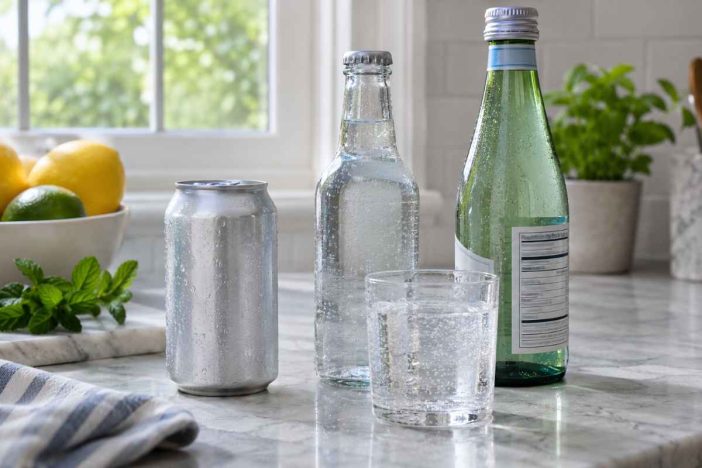
The bubbles look identical. Two cans sit next to each other in the grocery aisle, both promising a crisp, refreshing drink without sugar. One lists 0 milligrams of sodium. The other contains sodium compounds that were added for taste.
At first glance, there is little reason to expect a difference. Both are clear, carbonated, and sold alongside other sparkling waters.
Yet carbonation and sodium are two different things.
Carbon dioxide creates the fizz. Minerals—either naturally present or added during production—help determine how much sodium ends up in the drink.
For someone simply choosing a refreshing beverage, the difference might be small. For someone comparing several bottles a day or following a sodium-restricted diet, it is worth knowing what is actually inside.
Does Sparkling Water Have Sodium?
Some sparkling waters contain sodium, and others have little or none. There is no single sodium amount that applies to every product sold as sparkling water.
The amount depends on the water source, the minerals naturally present, and whether manufacturers add ingredients such as sodium bicarbonate or sodium citrate.
Plain seltzer typically has little or no sodium. Club soda commonly contains added mineral salts, some of which may contribute sodium. Sparkling mineral water can contain naturally occurring sodium at levels that vary by source.
That does not mean all club sodas are high in sodium or that all mineral waters contain more sodium than seltzer.
The product’s current label is the deciding source.
This distinction is especially important because shoppers often use the terms soda water, sparkling water, seltzer, and club soda interchangeably, even though their formulations can differ.
Why Some Carbonated Waters Contain More Sodium
Carbonation itself does not require sodium.
Manufacturers can add carbon dioxide to plain water without adding salt. Sodium enters the picture through the water’s mineral composition or through ingredients added for flavor and formulation.
Seltzer: Usually the Simplest Starting Point
Traditional plain seltzer is water with added carbonation and generally contains no added mineral salts.
That makes it a useful category to check when you want a fizzy drink without sodium additives.
However, flavored products can have additional ingredients, and formulations vary. Some beverages marketed as sparkling water may also contain juice, sweeteners, or other additions.
A category name is a clue, not a substitute for the label.
Club Soda: Mineral Salts Can Change the Number
Club soda is typically carbonated water with added mineral ingredients.
These may include sodium bicarbonate, sodium citrate, or other mineral salts, depending on the manufacturer.
Sodium-containing ingredients contribute sodium to the finished beverage. Ingredients such as potassium sulfate, however, do not contribute sodium merely because they appear alongside sodium compounds.
A club soda can therefore taste slightly mineral-like or salty without containing the same sodium amount as another brand.
For the broader difference between beverage categories, see our comparison of soda water and sparkling water.
Sparkling Mineral Water: The Source Matters
Mineral waters obtain their mineral composition from their source.
Depending on the source, the water may contain calcium, magnesium, sodium, bicarbonate, and other dissolved minerals.
Those minerals are not present in identical proportions across brands.
One sparkling mineral water may contain relatively little sodium; another may contain more.
Some products publish detailed mineral analyses in milligrams per liter. Others provide Nutrition Facts information or a mineral-content statement.
If you are specifically comparing sodium, check the sodium amount rather than assuming that the word mineral means a high-sodium product.
Seltzer vs Club Soda vs Mineral Water: A Sodium Comparison
This table describes typical product characteristics, not guaranteed sodium values.
| Beverage | Source of carbonation | Potential sodium source | What to verify |
|---|---|---|---|
| Plain seltzer | Added carbon dioxide | Usually none added | Sodium listed on label |
| Club soda | Added carbon dioxide | Added sodium-containing mineral salts | Sodium per serving and ingredient list |
| Sparkling mineral water | Natural or added carbonation, depending on product | Naturally occurring minerals | Sodium amount and mineral analysis |
| Flavored sparkling water | Varies | Original water or added ingredients | Sodium, sugars, sweeteners, and serving size |
| Tonic water | Added carbonation | Depends on formulation | Sodium and added sugars |
Tonic water deserves special attention because it is not simply another name for unsweetened sparkling water. Traditional tonic products contain quinine and may contain added sugar.
The categories also have regulatory distinctions. The FDA’s bottled-water guidance explains that products identified as seltzer, soda water, club soda, and tonic water are treated differently from regulated bottled-water categories.
For everyday shopping, the practical point remains the same: compare the actual product, not the category’s reputation.
How to Check Sodium on a Sparkling Water Label
A quick label check can answer most questions without researching a brand online.
Use this sequence:
1. Find the serving size
Start with the amount of beverage represented by the Nutrition Facts information.
For example, a label might use:
- One 12-fluid-ounce can
- One 8-fluid-ounce serving
- One bottle
These are examples, not standardized serving sizes for every sparkling-water product.
If the package contains more than one serving, the sodium listed for a single serving may not reflect everything you drink.
2. Read sodium in milligrams
Find the line labeled Sodium.
The amount is generally expressed in milligrams (mg).
A label may list 0 mg, 10 mg, 35 mg, or another amount depending on the product.
These numbers are not interchangeable, but they also need context.
For example, 20 mg in a small serving and 20 mg in an entire large bottle describe different concentrations.
3. Check the Percent Daily Value
For U.S. nutrition labeling, the FDA’s general Daily Value for sodium is 2,300 mg.
The percentage on the label indicates how much a serving contributes to that reference amount.
The FDA uses these general interpretation guidelines:
- 5% DV or less: Low contribution to the Daily Value
- 20% DV or more: High contribution to the Daily Value
These thresholds help interpret nutrient contributions. They should not be confused with every regulated front-of-package nutrient-content claim, which may have additional requirements.
For the full guidance, see the FDA’s Sodium in Your Diet resource.
4. Check servings per container
If you drink the entire container, use the number of servings to estimate the total sodium consumed.
Suppose a fictional bottle lists:
- Serving size: 8 fl oz
- Servings per container: 3
- Sodium: 25 mg per serving
The estimated sodium amount for the entire bottle is:
25 mg × 3 = 75 mg
That is different from reading 25 mg and assuming the whole bottle contains only that amount.
5. Look at the ingredients
Ingredients can help explain where sodium comes from.
Examples of sodium-containing ingredients include sodium bicarbonate and sodium citrate.
But the ingredient list is not a precise sodium measurement.
A small amount of a sodium-containing ingredient may contribute relatively little sodium, while naturally occurring minerals can contribute sodium even when no sodium compound has been separately added.
The measured or declared sodium amount is more useful than counting ingredient names.
The Sparkling Water Sodium Check: A Practical Example
Imagine three fictional sparkling-water products.
These examples illustrate label interpretation and do not represent actual brands.
| Label detail | Seltzer A | Club Soda B | Mineral Water C |
|---|---|---|---|
| Sodium per labeled serving | 0 mg | 35 mg | 15 mg |
| Serving size | 12 fl oz | 8 fl oz | 8 fl oz |
| Container size | 12 fl oz | 12 fl oz | 16 fl oz |
| Estimated sodium per container | 0 mg* | About 53 mg | 30 mg |
The 0 mg figure is the amount declared on the hypothetical label; it does not necessarily establish absolute absence of sodium.
The club soda appears to provide the most sodium per equivalent fluid amount.
But notice what happens if a shopper only reads the 35 mg figure without checking the serving size.
A 12-ounce container contains one and a half of the labeled 8-ounce servings.
That changes the amount consumed from 35 mg to approximately 52.5 mg, typically rounded here to about 53 mg for illustration.
The calculation is:
Sodium per container = sodium per serving × number of servings consumed
This is a useful estimate, not a laboratory measurement. Nutrition Facts values may be rounded under labeling rules.
What if the label uses milligrams per liter?
Mineral-water analyses often report sodium in mg/L.
To estimate sodium for the amount you drink:
Sodium consumed (mg) = sodium concentration (mg/L) × volume consumed (L)
For example, consider a hypothetical mineral water containing 40 mg/L of sodium.
A 500 mL bottle contains 0.5 L.
40 × 0.5 = 20 mg sodium in that bottle.
Be careful not to confuse a product’s sodium concentration with its total mineral content or total dissolved solids. Those figures measure different things.
Does “0 mg Sodium” Mean Absolutely No Sodium?
Not necessarily.
U.S. labeling regulations permit certain nutrient quantities to be rounded according to defined rules.
For sodium, a declared amount of 0 mg can represent a sufficiently small quantity below the applicable labeling threshold rather than a laboratory result of exactly zero.
This is a useful distinction, but it should not make routine shopping unnecessarily complicated.
For most people, the practical difference between a genuinely sodium-free drink and one with a trace amount rounded to zero is unlikely to be the main issue in their overall dietary sodium intake.
If you have been given a strict medical sodium restriction, however, use the product information and your healthcare team’s guidance rather than assuming that every label rounded to zero is identical.
Is Sodium in Sparkling Water Bad for You?
Sodium is an essential nutrient involved in fluid balance and normal nerve and muscle function.
The issue is not that sodium itself is harmful in every amount. It is that excess sodium intake can contribute to elevated blood pressure and associated health risks.
The FDA recommends that adults generally limit sodium consumption to less than 2,300 mg per day.
However, a sparkling water containing a small amount of sodium is not automatically an unhealthy drink.
Its significance depends on how much you drink, the rest of your diet, and whether you have an individualized sodium limit.
Consider your total diet, not one bottle
Most dietary sodium comes from food rather than from plain drinking water.
Prepared meals, breads, sauces, processed meats, and other foods can contribute substantial sodium.
A beverage with 15 mg of sodium is therefore not equivalent to a food containing several hundred milligrams simply because both list sodium on the label.
The useful question is: how much does this beverage contribute to your overall intake?
When a medical condition changes the decision
People with conditions such as heart failure, certain kidney disorders, or other circumstances requiring sodium or fluid management may receive individualized dietary guidance.
In those cases, beverage quantity can matter alongside sodium content.
A general article cannot determine your personal sodium or fluid allowance.
If you have been advised to restrict either, follow your clinician’s or registered dietitian’s instructions and check product labels carefully.
How to Choose a Lower-Sodium Sparkling Water
The selection process does not need to be complicated.
Start by deciding what you want from the drink.
If you simply want carbonation, a plain seltzer labeled with 0 mg sodium may be a straightforward option.
If you enjoy mineral water, compare its mineral information rather than rejecting the entire category.
If you prefer club soda in a mocktail, compare brands and examine sodium per amount consumed.
There is no requirement to stop drinking every product containing a small amount of sodium.
A Five-Point Buying Checklist
Before selecting a sparkling beverage, ask:
- What exactly am I buying? Seltzer, club soda, sparkling mineral water, flavored sparkling water, or tonic?
- How much sodium is listed? Read milligrams, not merely claims on the front.
- How much will I drink? Calculate sodium for the actual portion or full container.
- Are there additional ingredients? Look for added sugar, sweeteners, acids, or flavoring ingredients where relevant.
- Does the beverage fit my dietary requirements? Consider any clinician-recommended restrictions and your usual food intake.
This checklist also works when shopping online, although an online nutrition panel may not reflect a recent formulation change.
When the physical package is available, use its current label.
Sodium Is Only One Difference Between Sparkling Drinks
A zero-sodium beverage is not automatically the most suitable choice for everyone.
Consider what else distinguishes the products.
Plain, unsweetened sparkling water can contribute to fluid intake much like still water.
Sweetened tonic water may supply added sugars.
Flavored carbonated beverages can contain acidic ingredients, and frequent exposure to acidic drinks may matter for dental health.
Carbonation may also cause belching or bloating in some individuals.
These concerns should not be combined into a blanket statement that carbonated water is harmful.
Our article examining whether carbonated water is bad for you explores the broader health questions separately.
For readers interested in soda water as an everyday beverage, our guide to soda water and its potential benefits provides additional context.
The sodium-focused decision is simpler: know the amount, understand the portion, and decide whether it matters for your needs.
Frequently Asked Questions
Does plain sparkling water usually contain sodium?
Plain sparkling water may contain little or no sodium, but the amount varies by product. Some drinks are simply carbonated water, while others contain naturally occurring minerals or added sodium compounds. Check the sodium line on the label rather than assuming all unsweetened sparkling waters have identical mineral contents.
Is club soda higher in sodium than seltzer?
Club soda often contains added mineral salts, including sodium-containing ingredients, while traditional plain seltzer typically does not. However, brands and formulations vary. To make a reliable comparison, check the sodium milligrams and serving sizes on both packages rather than relying on their beverage names alone.
Can I drink sparkling mineral water on a low-sodium diet?
Possibly, depending on the product’s sodium content and your individual dietary restriction. Mineral waters vary substantially in composition. Compare sodium per bottle or serving, and account for other foods and beverages. If you have a medically prescribed sodium or fluid limit, ask your healthcare professional about suitable choices.
Let the Sodium Number Make the Decision
The answer to “does sparkling water have sodium?” is not a universal yes or no.
Some sparkling waters contain virtually none, while others contain sodium from natural minerals or added ingredients.
That difference becomes clear once you check the sodium amount, serving size, and the volume you actually drink.
You do not need to memorize which brand is supposedly the healthiest or avoid every mineral-containing beverage.
You need a comparison that uses the same measurements.
The next time two sparkling waters look identical on the shelf, turn them around. The information that matters may be on the back—not in the bubbles.