
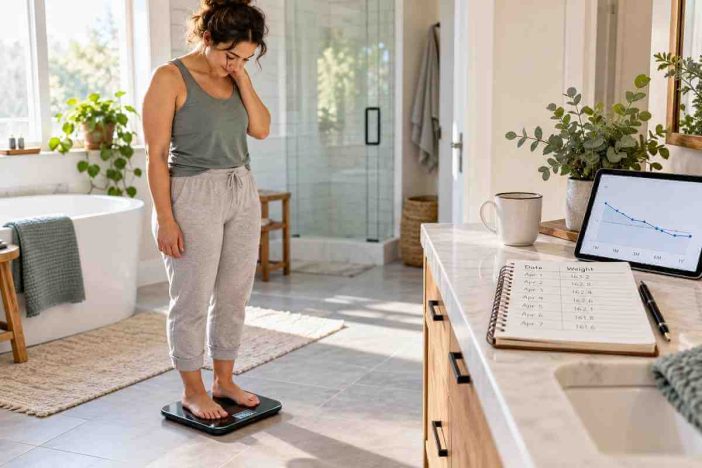
Daily weighing can reveal useful trends, but it can also turn harmless water fluctuations into false alarms. The right weighing frequency is not simply “daily” or “weekly”—it depends on whether the numbers help you make better decisions or tempt you to react to normal biological noise.
The scale was lower yesterday.
This morning it is up 1.8 pounds.
Nothing dramatic happened in between. Dinner was a little saltier than usual. You trained later in the day. Maybe you slept poorly. Yet one number is enough to make yesterday’s sensible plan suddenly feel wrong.
That is one of the paradoxes of weight tracking: a scale can provide useful feedback, but only when the person using it understands what the measurement can—and cannot—tell them.
A bathroom scale measures total body weight at one moment. It does not separately identify fat, water, glycogen, food still being digested, or other short-term changes. That makes how often you weigh yourself less important than how consistently you measure and how intelligently you interpret the resulting trend.
So, How Often Should You Weigh Yourself?
For many adults pursuing weight loss or maintenance, daily or weekly self-weighing can both be reasonable approaches.
Daily weighing provides more data and can make trends easier to detect. Weekly weighing creates less noise and may suit people who do not want body weight occupying attention every morning.
Research does not support one universal schedule for every person.
Some studies have associated frequent or daily self-weighing with better weight-management outcomes, particularly when weighing is combined with other behaviors such as nutrition tracking, physical activity, goal setting, and feedback. A 2024 systematic review found regular self-monitoring of weight useful as part of behavioral weight management.
But frequency should not be confused with treatment.
An earlier meta-analysis found that adding self-weighing to a broader behavioral program may improve outcomes, while evidence was insufficient to conclude that simply telling someone to weigh every day is an effective stand-alone weight-loss intervention. The same analysis did not find a clear advantage of daily over weekly weighing across the included interventions.
That distinction matters.
The scale is a monitoring tool, not a weight-loss method.
Daily vs Weekly Weighing: What Actually Changes?
The two approaches answer slightly different needs.
| Approach | Main advantage | Main limitation | May fit people who |
|---|---|---|---|
| Daily weighing | Produces enough measurements to reveal a trend | Shows every short-term fluctuation | Can view numbers neutrally and use averages |
| Weekly weighing | Simple and less mentally intrusive | One unusual day can distort the week’s measurement | Prefer lower-frequency monitoring |
| Less than weekly | Minimal attention to scale weight | Makes trend changes harder to recognize | Use other progress measures or clinician-guided monitoring |
| No routine self-weighing | Appropriate in some circumstances | Removes one objective trend measure | Find weighing psychologically harmful or have been advised not to self-weigh |
The Centers for Disease Control and Prevention includes weekly weight recording among possible strategies for monitoring weight maintenance. NHLBI, meanwhile, notes that daily weighing has helped many people with both initial and long-term weight management.
These recommendations are not necessarily contradictory.
They illustrate a more useful principle: regular, consistent monitoring matters more than finding a mythical perfect frequency.
What Daily Weighing Does Better
Daily weighing creates a larger dataset.
If you weigh once every seven days, you might compare:
- 178.2 lb this Monday
- 179.1 lb next Monday
- 177.8 lb the following Monday
Those measurements look erratic.
But daily readings might reveal that the second Monday followed a restaurant meal and was surrounded by six lower measurements.
With more observations, it becomes easier to distinguish an isolated spike from a persistent change.
Research has also found associations between regular self-weighing and greater adoption of other weight-control behaviors. One study involving adults with overweight found that participants who weighed daily adopted more weight-management behaviors and lost more weight than those weighing somewhat less frequently. However, this type of finding should not be interpreted as proof that the act of stepping on a scale itself caused all of the difference.
People willing to monitor consistently may also be more engaged with other parts of their program.
What Weekly Weighing Does Better
Weekly weighing reduces the amount of attention given to daily changes.
That can be valuable when a person already follows a stable eating and activity routine and only needs occasional confirmation that body weight is remaining within an expected range.
It may also be more appropriate when daily numbers create unnecessary reactions such as:
- cutting food after a single increase,
- adding extra exercise to “compensate,”
- repeatedly checking the scale,
- allowing the reading to determine mood for the day.
A weekly schedule still needs consistency.
If possible, compare measurements taken under similar conditions rather than comparing a Sunday evening weight after dinner with a Friday morning weight before breakfast.
Why Your Weight Changes Even When Your Body Fat Has Not
One of the biggest mistakes in weight management is interpreting every scale change as a change in body fat.
Total body weight also reflects:
- body water,
- glycogen,
- food and fluid inside the digestive tract,
- bowel contents,
- clothing,
- menstrual-cycle-related changes for some people,
- recent sodium and carbohydrate intake,
- and changes associated with training and recovery.
That is why someone can follow the same eating plan and still wake up noticeably heavier or lighter from one day to the next.
A detailed explanation of water retention versus fat gain belongs in the dedicated HealthBeautyIdea guide on that subject rather than being repeated here. The practical lesson for self-weighing is simpler:
a single measurement is weak evidence of a change in body fat.
The Best Time to Weigh Yourself
If you choose to monitor body weight, measurement conditions should be as repeatable as practical.
A common approach is to weigh:
- in the morning,
- after using the bathroom,
- before eating or drinking,
- on the same scale,
- with similar clothing or no clothing,
- with the scale on the same firm surface.
Cleveland Clinic similarly recommends morning weighing after using the restroom and before food or drink because this reduces some of the variability introduced during the day.
The objective is not to produce a magically “true” weight.
Body weight always fluctuates.
The objective is to reduce unnecessary measurement noise so that one reading can be compared more fairly with another.
Do Not Compare Today With Yesterday—Compare Trends
This is where scale tracking becomes genuinely useful.
Suppose your seven morning weights are:
| Day | Weight |
|---|---|
| Monday | 180.2 lb |
| Tuesday | 179.8 lb |
| Wednesday | 180.5 lb |
| Thursday | 179.9 lb |
| Friday | 180.0 lb |
| Saturday | 181.1 lb |
| Sunday | 179.6 lb |
Looking only at Friday versus Saturday creates the impression of a sudden 1.1-pound gain.
Looking at the entire week tells a very different story.
The average is approximately 180.2 pounds.
That average can then be compared with the average from another week measured under similar conditions.
This approach does not make scale weight perfect, but it reduces the influence of individual highs and lows.
The HealthBeautyIdea Three-Layer Weight Trend Method
Instead of allowing each measurement to trigger a decision, use three layers.
Layer 1: Standardize the Measurement
Before interpreting changes, ask whether the measurements were reasonably comparable.
Were they:
- taken at approximately the same time?
- taken on the same scale?
- taken under similar clothing conditions?
- affected by an unusually large meal, alcohol, travel, illness, constipation, or hard training?
If the measurement conditions changed dramatically, treat the number cautiously.
Layer 2: Look for a Trend Window
One measurement tells you what the scale said that day.
Several measurements tell you more about direction.
For daily weighers, a seven-day average can reduce noise. For weekly weighers, comparing several weeks is usually more informative than reacting to two adjacent readings.
The key question is not:
“Did my weight go up?”
It is:
“Has my weight trend changed consistently?”
Layer 3: Decide Whether Anything Actually Needs Changing
Avoid changing calories, exercise, or an otherwise sustainable routine because of one unusual weigh-in.
A more useful sequence is:
- confirm that the change persists,
- review eating and activity patterns,
- consider obvious causes of temporary fluctuations,
- look at additional progress measures,
- then decide whether the plan actually requires adjustment.
This matters particularly during a weight-loss plateau.
There are many reasons progress can slow, from changing energy needs to adherence, sleep, medications, medical conditions, and changes in spontaneous activity. The HealthBeautyIdea guide explaining why weight loss can become difficult covers those causes in greater depth.
A Scale Cannot Tell You Your TDEE
Another common mistake is using one weight change to reverse-engineer a supposedly exact calorie requirement.
For example:
“I gained a pound, therefore I ate exactly 3,500 calories too much.”
Real human weight change is not that precise.
Body-weight measurements contain water and gastrointestinal variation, while energy expenditure itself changes with body size, movement, food intake, exercise, and other factors.
If your goal is estimating maintenance energy needs, start with an understanding of BMR versus TDEE and then refine the estimate using real-world trends over time.
Even validated calorie equations are estimates rather than direct measurements of what an individual burns on a particular day.
Use More Than One Progress Signal
Body weight can be useful, but it should not have to carry the entire burden of measuring progress.
Depending on the person’s goal, useful information may also include:
- waist circumference,
- how clothing fits,
- strength or exercise performance,
- walking capacity,
- consistency of eating habits,
- blood pressure or laboratory values when medically relevant,
- energy and recovery,
- and whether the plan is sustainable enough to continue.
These signals answer different questions.
A scale can indicate changes in total mass.
It cannot tell you whether your sleep improved, your strength increased, your eating became more consistent, or your cardiovascular fitness improved.
What If You Are Maintaining Weight After Weight Loss?
Maintenance changes the role of weighing.
During active weight loss, someone may watch for a downward trend.
During maintenance, the goal is usually stability within a reasonable range, not producing the exact same number every morning.
Research suggests that regular self-weighing can be useful for weight maintenance. One study found that greater consistency of self-weighing was associated with less weight regain after a weight-loss program, although frequency alone did not independently predict weight change in that analysis.
That is another reason consistency may be a more useful concept than obsessing over an exact number of weigh-ins.
And if maintenance becomes unexpectedly difficult, the issue may extend beyond the scale itself. HealthBeautyIdea’s guide to why weight regain happens after dieting explains the biological and behavioral changes that can make maintaining a lower weight challenging.
When Daily Weighing May Not Be the Right Tool
A strategy can be helpful on average without being appropriate for every person.
Daily self-weighing should be reconsidered if it repeatedly leads to:
- significant anxiety,
- compulsive checking,
- skipping meals because of a morning number,
- compensatory exercise,
- rigid restriction,
- binge–restrict cycles,
- or persistent preoccupation with body weight.
Research reviews in adults undergoing weight-management interventions generally have not found regular self-weighing to cause adverse psychological outcomes across study populations. But population averages cannot determine what is appropriate for an individual person.
People with an eating disorder, a history of problematic restrictive eating, significant distress around body weight, pregnancy, certain medical conditions, or clinician-directed nutritional treatment should follow individualized professional guidance rather than adopting a weighing schedule from a general article.
Common Mistakes That Make the Scale Less Useful
Weighing at Random Times
Morning one day and evening the next introduces large differences in food, fluid, and clothing weight.
Reacting to One Number
A single increase rarely provides enough information to justify changing an eating plan.
Changing the Plan Before Confirming the Trend
Cutting calories every time weight rises can create an unnecessarily restrictive cycle.
Ignoring Water and Glycogen
Short-term increases can happen without a comparable increase in body fat.
Treating a Calculator as More Accurate Than Your Data
Estimated calorie requirements are useful starting points, not exact prescriptions.
Letting the Scale Become the Goal
A sustainable weight-management plan should support health and daily function rather than turn one measurement into a daily verdict.
A Practical Decision Framework
Choose daily weighing when:
- you prefer data,
- fluctuations do not strongly affect your mood,
- you are willing to interpret averages rather than individual readings,
- and monitoring helps you stay consistent.
Choose weekly weighing when:
- you want a simpler routine,
- daily fluctuations create distraction,
- you are primarily monitoring long-term stability,
- or you already have reliable habits and need less frequent feedback.
Consider less frequent or clinician-guided weighing when:
- scale monitoring causes significant distress,
- you have a history of disordered eating,
- your medical or nutritional care requires another approach,
- or another progress measure is more appropriate.
None of these schedules compensates for an unsustainable diet.
For the broader nutrition, activity, sleep, and behavior framework, HealthBeautyIdea’s evidence-based weight loss and diet planning guide should remain the central resource.
Frequently Asked Questions
Is it better to weigh yourself every day or once a week?
Both can work. Daily weighing provides more data for calculating trends, while weekly weighing may be easier for people distracted by normal day-to-day fluctuations. Evidence supports regular self-monitoring as part of weight management, but no single frequency is ideal for everyone.
Why does my weight change so much from day to day?
Body weight includes much more than fat. Water, glycogen, food and fluid intake, bowel contents, sodium, carbohydrate intake, training, and hormonal changes can alter short-term readings. Look at repeated measurements rather than interpreting every increase as fat gain.
What time of day should I weigh myself?
For consistency, morning is usually practical—after using the bathroom and before eating or drinking. Use the same scale and similar clothing conditions. Consistent measurement conditions matter more than achieving a supposedly perfect number.
Should I change my diet if my weight goes up overnight?
Usually, one reading is not enough information to justify changing an otherwise appropriate plan. First determine whether the increase persists across a meaningful trend and consider temporary causes such as water retention, meal size, sodium, carbohydrate intake, or training.
Make the Scale Answer a Question, Not Create One
The most useful scale is not necessarily the one you step on most often.
It is the one that helps you see direction without turning ordinary fluctuations into emergencies.
For some people, daily weighing provides excellent trend data. For others, weekly weighing produces enough information with far less mental noise. And for some people, routine self-weighing is not a useful tool at all.
The durable principle is consistent measurement, trend-based interpretation, and proportionate action.
Weight management becomes more sustainable when today’s number is treated as one data point—not a command to eat less, exercise more, or abandon a plan that may still be working.