
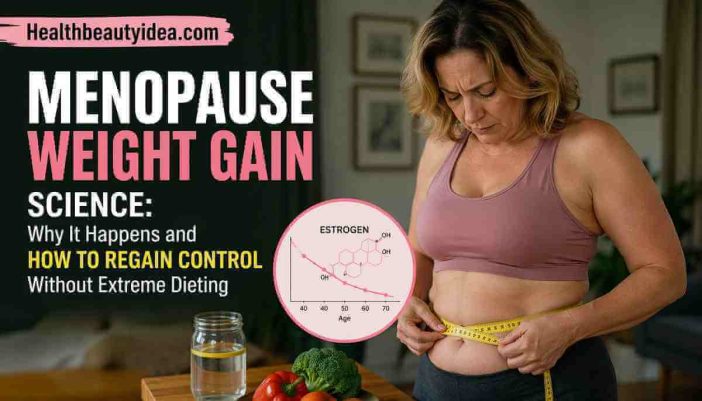
It rarely begins as a dramatic change. A few pounds that do not move. A waistline that feels different. Energy that dips without a clear reason. What used to work—cutting calories, adding exercise—now produces smaller results or none at all.
This is where menopause weight gain becomes misunderstood.
The issue is not simply “aging.” It is a coordinated shift in hormones, fat distribution, metabolism, and energy regulation. Without understanding those changes, most strategies fail—not because they are wrong, but because they are incomplete.
What Causes Menopause Weight Gain? (Clear Answer)
Menopause weight gain occurs primarily due to declining estrogen levels, which shift fat storage toward the abdomen, reduce metabolic flexibility, and alter appetite and energy regulation. This is often combined with age-related muscle loss and lifestyle factors, making fat loss slower and weight gain easier.
What Actually Changes During Menopause
Estrogen Decline and Fat Redistribution
Estrogen is not just a reproductive hormone. It influences:
- Fat storage location
- Insulin sensitivity
- Appetite signaling
When estrogen declines:
- Fat shifts from hips and thighs → abdomen
- Visceral fat increases
- Metabolic risk rises
This is why many women suddenly develop central belly fat, even without major lifestyle changes.
This mechanism connects directly with Hormonal Belly Fat (Men vs Women).
Muscle Loss and Lower Energy Expenditure
With age and hormonal changes:
- Muscle mass decreases
- Resting metabolism declines
Muscle is metabolically active tissue.
Less muscle means:
- Fewer calories burned at rest
- Lower tolerance for overeating
- Faster fat accumulation
This links strongly with NEAT and Daily Fat Burning.
Insulin Sensitivity Changes
During menopause:
- Cells may respond less efficiently to insulin
- Blood sugar regulation becomes less stable
This leads to:
- More fat storage
- Increased hunger cycles
- Energy crashes
This overlaps with Insulin Resistance and Weight Loss Plateaus.
Sleep Disruption and Cortisol
Hot flashes, night waking, and poor sleep quality:
- Raise cortisol levels
- Increase appetite
- Reduce recovery
Chronic stress + poor sleep = stronger fat storage signals
See Cortisol and Belly Fat and Circadian Rhythm.
Why Traditional Dieting Stops Working
Here is where many women get stuck.
The classic model:
Eat less → move more → lose weight
During menopause, this becomes unreliable because:
- Metabolism adapts faster
- Hormonal signals resist fat loss
- Hunger increases under restriction
This is explained by Adaptive Thermogenesis.
The result:
- More effort
- Less progress
- Higher frustration
Menopause Belly Fat vs General Weight Gain
Key distinction:
| Type | What It Means |
|---|---|
| Subcutaneous fat | Stored under skin, less risky |
| Visceral fat | Surrounds organs, metabolically active |
During menopause:
- Visceral fat increases
- Fat becomes more hormonally driven
See Visceral Fat vs Subcutaneous Fat.
Practical Strategy: What Actually Works
This is not about extreme dieting. It is about adjusting to a different metabolic environment.
Prioritize Protein Intake
Protein helps:
- Preserve muscle
- Improve satiety
- Support metabolism
This aligns with Protein for Weight Loss.
Increase Fiber and Gut Support
Fiber helps regulate:
- Blood sugar
- Appetite
- Gut microbiome
See Fiber for Weight Loss and Gut Health.
Strength Training Is Non-Negotiable
Resistance training:
- Slows muscle loss
- Supports metabolic rate
- Improves insulin sensitivity
Cardio alone is not enough.
Stabilize Blood Sugar
Focus on:
- Balanced meals
- Avoiding extreme spikes
- Consistent eating patterns
This supports metabolic stability rather than short-term restriction.
Reduce Chronic Stress Load
Stress drives:
- Cortisol elevation
- Belly fat accumulation
Stress management is not optional in this phase.
Respect Energy, Not Just Calories
Many women under-eat during menopause.
This leads to:
- Hormonal stress
- Metabolic slowdown
- Plateau or rebound
The goal is stability, not aggressive deficit.
Common Mistakes During Menopause Weight Loss
Mistake 1: Cutting Calories Too Aggressively
Leads to metabolic adaptation and muscle loss.
Mistake 2: Ignoring Strength Training
Without muscle, metabolism declines faster.
Mistake 3: Over-Relying on Cardio
Burns calories but does not preserve metabolic capacity.
Mistake 4: Blaming Everything on Hormones Alone
Hormones matter—but behavior still matters too.
Expert Insight: Menopause Is a Metabolic Transition, Not a Failure
From a systems perspective, menopause is not a breakdown—it is a transition.
The body shifts:
- Energy priorities
- Hormonal signaling
- Fat storage patterns
The mistake is trying to apply the same strategy that worked 10–15 years earlier.
Adaptation—not force—is what restores progress.
FAQ
Why do women gain belly fat during menopause?
Declining estrogen shifts fat storage toward the abdomen and increases visceral fat accumulation.
Is menopause weight gain inevitable?
No. It becomes easier to gain weight, but proper nutrition, strength training, and lifestyle adjustments can manage it effectively.
What is the best diet for menopause weight loss?
There is no single “best” diet. A balanced, protein-rich, fiber-supported approach with stable blood sugar works best long term.
What to Do Next (Action Framework)
Start here:
- Increase protein intake daily
- Add resistance training 2–3x per week
- Improve sleep consistency
- Reduce stress load intentionally
- Avoid extreme dieting
Then adjust based on response.
Closing Insight
Menopause weight gain is not random.
It follows a pattern:
- Hormonal shifts
- Metabolic adaptation
- Fat redistribution
Trying to fight it with more restriction usually fails.
What works is understanding the system:
- protect muscle
- stabilize hormones
- manage stress
- support metabolism
The goal is not to return to your past metabolism.
The goal is to build a new one that works with your current biology—not against it.