
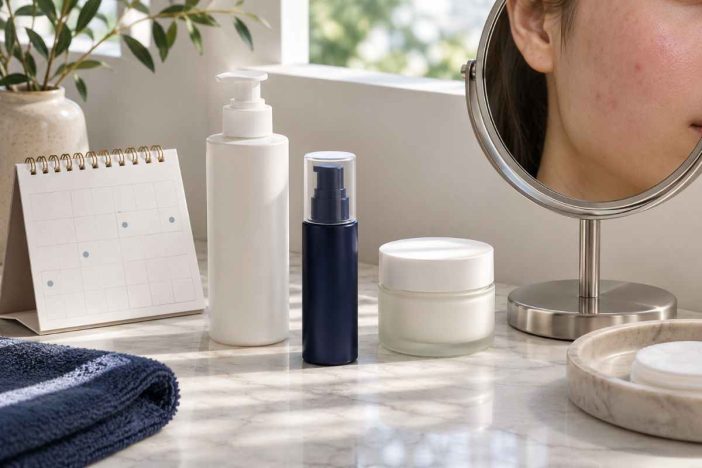
The trouble usually begins in front of a mirror.
There are three new bumps on your chin. Yesterday there was one. Your cheeks feel a little dry, and the retinoid you started recently suddenly seems like the obvious suspect.
A search for “skin purging vs breakout” gives you two conflicting instructions: keep going because it is working, or stop because your skin hates the product.
Neither is safe as a universal rule.
“Purging” is useful shorthand for an early worsening of acne that can occur after starting some acne treatments, particularly retinoids. But it is not a diagnosis you can confirm by looking at one pimple, counting four weeks, or checking whether the breakout is on your chin.
The better question is not simply, “Am I purging?”
It is:
What did I start, what changed, what symptoms appeared, and is the overall pattern improving or becoming more irritated?
Skin Purging vs Breakout: The Short Answer
Early worsening can genuinely occur with certain acne medications.
MedlinePlus notes that adapalene can make acne appear worse during the first few weeks, including bringing previously unseen pimples to the surface. It also notes that dryness or irritation may occur early in treatment and that full benefit can take considerably longer.
That does not mean every new skincare product can “purge” your skin.
Nor does it mean that burning, swelling, itching, or a spreading rash is evidence that a product is working.
Clinical research also complicates the simple social-media version of purging. Studies of topical retinoids have found that some patients experience early flares, while many improve rather than worsen. In other words, early worsening is possible, but it is not an obligatory stage of successful treatment.
Use the following five checks together rather than treating any one of them as a diagnostic test.
Check 1: What Product Did You Actually Start?
This is the most useful first question.
A retinoid deserves a different interpretation
Retinoids such as adapalene and tretinoin affect follicular keratinization and are established acne treatments. Early worsening has been recognized in medication information for adapalene, so new acne shortly after beginning one is at least biologically and clinically plausible.
If your new product is retinol, adapalene, or tretinoin, understanding the differences between them also matters. Our guide to retinol vs tretinoin explains why potency, irritation risk, and treatment expectations are not identical.
Exfoliating acids require more caution in interpretation
AHAs and BHAs are frequently included in discussions about purging because they alter exfoliation and can change how clogged pores behave.
But they can also simply irritate the skin, especially when used too frequently or combined with other strong actives.
That distinction matters. More bumps after an acid do not automatically prove that hidden acne is “coming out.”
A plain moisturizer is different
Suppose the only new product is a basic moisturizer, sunscreen, cleansing balm, foundation, face oil, or hydrating serum.
Those products are not normally being used to accelerate acne lesion turnover in the way an acne retinoid does.
If new breakouts repeatedly follow one of them, it is more useful to investigate the formula, application, other routine changes, or coincidence than to assume your skin needs to “purge.”
The fact that a product is new does not make every reaction an adjustment period.
Check 2: Did the Bumps Appear Where You Normally Break Out?
Location can provide context, but it cannot diagnose the problem.
If you normally develop closed comedones around the chin and the first weeks of an acne treatment produce additional small lesions in the same region, that pattern is more compatible with an early acne flare than a sudden crop of lesions in an area that has always been clear.
But treat location as a clue—not a rule.
Acne itself fluctuates. Hair products can affect the forehead. Occlusion can affect different regions. Hormonal acne can shift. Irritant reactions can also occur exactly where you applied the product.
Therefore:
same area = useful clue
not:
same area = proof of purging
That distinction protects you from continuing an irritating routine simply because the bumps appeared in a familiar place.
Check 3: Are You Seeing Acne—or Signs of Irritation?
This is where many “purging” decisions go wrong.
A whitehead is not the same signal as burning skin.
Symptoms such as:
- persistent burning;
- significant stinging;
- increasing redness;
- widespread scaling;
- marked itching;
- cracking;
- swelling;
- blistering;
- or a rash-like pattern
should make you think beyond ordinary acne.
AAD notes that irritation from retinoids can occur and may sometimes be managed by changing the amount, frequency, or moisturizer strategy under professional guidance.
If your new bumps arrive together with burning, peeling, tightness, and rapidly reduced tolerance to products, review our guide to a damaged skin barrier. That symptom cluster deserves a different response from a few additional comedones without irritation.
Do not use the word “purging” to normalize symptoms that are progressively becoming more painful or inflammatory.
Check 4: What Else Changed at the Same Time?
Imagine this routine change:
Monday: new retinol.
Wednesday: new glycolic toner.
Friday: new niacinamide serum.
Saturday: facial scrub.
Sunday: five new bumps and burning cheeks.
At that point, asking whether “the retinol is purging” misses the larger problem.
You have created too many variables.
A useful skincare experiment changes one major variable at a time. That makes both improvement and problems easier to interpret.
When several actives are introduced together, you cannot reliably tell whether you are seeing:
- ordinary acne fluctuation;
- irritation;
- an early medication flare;
- a reaction to one formulation;
- over-exfoliation;
- or several problems at once.
Return to a simpler basic skin care routine while you determine what your skin actually tolerates.
Skincare troubleshooting is much easier when your routine is boring enough to troubleshoot.
Check 5: What Direction Is Your Skin Moving?
A calendar matters, but a rigid countdown can mislead you.
You will often read that purging “must” finish in four or six weeks. That is too precise to use as a universal diagnostic rule.
For adapalene, official patient information says acne may initially worsen and that 8–12 weeks or longer may be needed for full benefit. That does not mean you should endure any reaction for twelve weeks; it means treatment response and irritation cannot be judged by a simplistic four-week rule.
Instead, look at the direction of travel.
Ask:
- Are new lesions becoming fewer?
- Is your skin becoming more comfortable?
- Is redness decreasing or increasing?
- Are you developing lesions in completely new areas?
- Is irritation becoming harder to tolerate?
- Are breakouts becoming deeper or more painful?
- Is there any overall improvement?
A mild early flare that gradually settles is very different from a routine that becomes more inflamed every week.
Purging, Breakout, or Irritation? Use the Pattern, Not One Sign
| Pattern | Possible early treatment flare | More consistent with breakout | More concerning for irritation/reaction |
|---|---|---|---|
| Started after an acne retinoid | More plausible | Still possible | Also possible |
| Started after plain moisturizer or makeup | Weak explanation | More plausible | Possible |
| Mostly usual acne areas | Supports the possibility | Can still occur | Can still occur |
| New unfamiliar areas | Less reassuring | More plausible | Possible |
| Whiteheads/comedones similar to usual acne | Possible | Possible | Less typical |
| Burning or strong stinging | Not a reassuring purge sign | Sometimes accompanies inflamed acne | More concerning |
| Itching or rash-like redness | Not a reassuring purge sign | Less typical | More concerning |
| Swelling or blistering | Do not label as purging | Not typical acne | Needs prompt assessment |
| Overall trend improves | More reassuring | Possible with acne treatment | Less compatible with ongoing reaction |
| Overall trend keeps worsening | Reassess | Possible uncontrolled acne | Reassess urgently if irritation is significant |
This framework is a decision aid, not a diagnosis.
“Purging” Does Not Mean Your Skin Is Detoxing
One of the least useful explanations is that a skincare product is “pulling toxins” or “impurities” out of your skin.
That language sounds intuitive, but it does not accurately describe acne biology.
Acne lesions develop within the pilosebaceous unit through processes involving follicular plugging, sebum, inflammation, and other factors. Some acne treatments change follicular cell turnover, which helps explain why lesion behavior can change after treatment starts.
That is very different from toxins being pushed through the skin.
If a product makes your face increasingly inflamed, you do not earn better results by enduring the irritation because someone called it “detox.”
Which Ingredients Are Most Relevant to the Purging Question?
Adapalene
Adapalene provides one of the clearest examples because official medication information explicitly acknowledges that acne can appear worse during the early weeks.
DailyMed also warns that irritation such as redness, itching, dryness, and burning may occur, especially early in treatment or when multiple topical acne medications are used together.
This creates an important distinction:
early acne worsening can occur, and irritation can also occur.
They are not automatically the same phenomenon.
Tretinoin
Tretinoin can also cause dryness, peeling, erythema, and irritation.
Research examining early acne flares found them in a subset of patients, rather than showing that everyone must pass through a worsening stage before improving.
If you are deciding between OTC retinol and prescription tretinoin, our retinol vs tretinoin comparison provides the broader treatment context.
Salicylic acid and AHAs
These ingredients alter exfoliation and are often described by skincare publications as possible triggers of purging.
The evidence is less straightforward than social media makes it appear.
They can unclog pores, but they can also cause irritation—particularly when frequency, concentration, or combinations exceed your skin’s tolerance.
If an exfoliating product produces burning, extensive peeling, or worsening sensitivity, do not automatically interpret those symptoms as a successful purge.
Niacinamide
Niacinamide is not usually used as a rapid cell-turnover acne medication.
If a niacinamide serum appears to trigger bumps, examine the complete formula, concentration, other products introduced at the same time, and whether the lesions are actually acne.
A product can disagree with your skin without needing to “purge” it first.
The Continue, Slow Down, or Stop Framework
The goal is not to tell every reader to quit or continue. The right decision depends heavily on what you are using and why.
Continue as directed when the pattern is mild and expected
Continuing may be reasonable when:
- you are using a recognized acne treatment;
- the changes are mild;
- there is no significant burning, swelling, rash, or blistering;
- the reaction is consistent with the product’s official instructions;
- and your skin is otherwise tolerating treatment.
If the medication is prescribed, follow the prescribing clinician’s plan.
Slow down and ask for guidance when irritation is becoming significant
If dryness, burning, scaling, or discomfort is making treatment difficult, do not simply add several “repair” products around it.
For retinoids, clinicians may sometimes change frequency, amount, moisturizer use, or formulation. AAD specifically discusses these approaches for reducing retinoid irritation.
Prescription treatment changes should be discussed with the prescriber.
Stop the suspect cosmetic product when there is a clear adverse reaction
A nonessential cosmetic product does not deserve unlimited chances.
Stop using a suspect product and seek appropriate medical advice when you develop significant swelling, blistering, hives, severe burning, or a rapidly spreading rash.
Difficulty breathing or swelling involving the lips, tongue, or throat requires urgent medical attention.
A 14-Day Skincare Troubleshooting Log
Instead of trying to remember what your skin looked like last Tuesday, collect useful information.
For the next two weeks, record:
| What to track | What to write down |
|---|---|
| New product | Exact product and active ingredient |
| Start date | First day used |
| Frequency | Every night, alternate nights, etc. |
| Other actives | Retinoids, acids, benzoyl peroxide, scrubs |
| Location | Where new lesions appeared |
| Type | Whitehead, blackhead, inflamed bump, rash-like patch |
| Sensation | None, tightness, stinging, burning, itching |
| Trend | Better, unchanged, or worse |
| Photos | Same lighting and approximate angle |
Do not use the log to diagnose yourself.
Use it to replace vague memory with information that can help you—and, if necessary, a dermatologist—understand what changed.
It is particularly valuable if you are someone whose skin reacts frequently. In that situation, our skincare routine for sensitive skin may help you reduce unnecessary variables before experimenting with additional actives.
Three Mistakes That Make Purging Harder to Interpret
Adding another acne treatment because the first one caused bumps
More treatment does not automatically correct an uncertain reaction.
Adding salicylic acid, benzoyl peroxide, and a scrub to an already irritating retinoid routine can turn a manageable adjustment into a damaged-barrier problem.
Assuming discomfort proves an active is powerful
Burning is not a potency badge.
An effective product should still be used in a way your skin can tolerate.
Changing the routine every few days
A skincare routine that changes constantly produces bad information.
If you replace products before you can assess the previous change, you may never know what helped—or what caused the problem.
When a Dermatologist Is More Useful Than Another Experiment
Professional assessment becomes more important when:
- acne is painful, nodular, cystic, or leaving scars;
- worsening continues despite appropriate use;
- you cannot distinguish acne from a rash;
- irritation is significant;
- lesions are appearing together with swelling or intense itching;
- you have a history of eczema, rosacea, or contact dermatitis;
- or a prescribed acne medication seems impossible to tolerate.
Acne treatment often takes time, but “give it time” should not become an excuse to ignore a serious reaction.
Frequently Asked Questions
Can a moisturizer cause skin purging?
A conventional moisturizer does not have the same acne-treatment mechanism as a retinoid, so new pimples after starting one should not automatically be called purging. Consider the formulation, other routine changes, ordinary acne fluctuation, and irritation instead.
Does niacinamide cause purging?
Niacinamide is not generally used as a rapid cell-turnover acne medication. A niacinamide product can still irritate some people or contain other ingredients that do not suit their skin, but new bumps alone do not prove a beneficial purge.
How long does skin purging last?
There is no validated universal countdown that distinguishes purging from a breakout. Adapalene information acknowledges early worsening and notes that full benefit may take 8–12 weeks or longer. Significant or progressively worsening irritation should be reassessed rather than endured according to a calendar.
When the Label Matters Less Than the Pattern
Skin purging vs breakout is not a choice you can always settle from a photograph or one rule about timing.
Start with the product. Look at what else changed. Separate acne lesions from burning, itching, swelling, and rash-like symptoms. Then watch whether the overall pattern is becoming calmer or increasingly irritated.
Most importantly, do not assume that worsening proves a skincare product is working.
Sometimes an acne treatment needs time. Sometimes the routine needs simplification. Sometimes your skin is telling you to stop experimenting and get professional help.
The safest decision comes from context and progression—not from forcing every new breakout into the “purging” label.
This article is for general educational purposes and does not diagnose acne, allergic reactions, contact dermatitis, or other skin conditions. Follow the instructions for prescribed medications and contact an appropriate healthcare professional when symptoms are severe, unusual, persistent, or worsening.