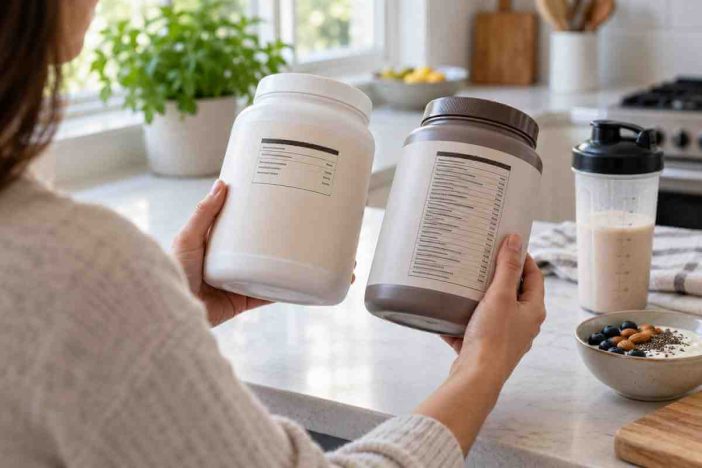
Is protein powder ultra processed? The question often starts with something surprisingly ordinary: a scoop sitting beside a shaker bottle.
The front of the tub might look simple—“25 g protein,” “plant based,” or “whey isolate.” Turn it around, however, and the picture can change. One powder may contain a single protein ingredient. Another may contain protein isolates, flavors, gums, emulsifiers, sweeteners, enzymes, vitamins, and several ingredients you would never keep in a home kitchen.
It is tempting to solve the problem with one rule:
More processing means worse food.
That rule is too simple.
Protein powder is a good example of why food processing and nutritional quality need to be evaluated separately. Many commercial protein powders fit characteristics used to identify ultra-processed foods, particularly when concentrated or fractionated proteins are combined with flavorings, sweeteners, emulsifiers, thickeners, and other formulation ingredients. But an ultra-processed classification alone does not tell you the amount of protein, added sugar, calories, sodium, allergens, or whether the product serves a useful purpose in someone’s diet.
The better approach is to ask two questions:
How extensively is this product formulated?
and
What does the finished product actually provide?
Quick Answer: Is Protein Powder Ultra-Processed?
Many commercial protein powders can reasonably fall into the ultra-processed category under the NOVA framework, particularly flavored products containing isolated or fractionated proteins plus ingredients such as sweeteners, flavors, emulsifiers, or thickeners.
But not every powder has the same formulation, and classifying a simple single-ingredient powder can be less straightforward than classifying a flavored ready-to-drink shake.
NOVA is also a food-processing classification system—not an FDA regulatory category and not a complete nutritional score.
So instead of deciding whether a protein powder is “good” or “bad” from the words ultra-processed alone, check:
- the actual protein source;
- how extensively the food has been fractionated or formulated;
- flavors, sweeteners, emulsifiers, gums, and similar additions;
- protein and calories per serving;
- added sugars and sodium;
- allergens;
- serving size;
- and how the powder fits into the rest of your diet.
If you first need to understand the difference between powders, prepared shakes, and meal replacements, read our guide to what is in a protein shake.
What Does “Ultra-Processed” Actually Mean?
The term ultra-processed food is most closely associated with the NOVA food classification system.
NOVA organizes foods into four broad groups according to the nature, extent, and purpose of processing:
- unprocessed or minimally processed foods;
- processed culinary ingredients;
- processed foods;
- ultra-processed foods.
Ultra-processed products are not defined simply as foods that have been cooked, ground, frozen, or packaged.
The NOVA framework focuses heavily on industrial formulations made using food-derived substances, fractionated ingredients, and additives that may modify flavor, color, texture, shelf life, or palatability.
A widely cited NOVA identification guide notes characteristics such as hydrolyzed proteins, flavorings, sweeteners, emulsifiers, thickeners, colors, and other ingredients rarely used in ordinary home kitchens.
That distinction matters because nearly all protein powders are processed in some way.
Milk does not naturally come out of a cow as whey isolate.
Peas do not grow as pea protein powder.
Soybeans do not begin as soy protein isolate.
Processing is required to separate, concentrate, dry, and formulate these proteins.
But processed and ultra-processed are not interchangeable terms.
Why Protein Powder Is Difficult to Classify With One Rule
Protein powder is not one standardized food.
A container labeled “protein powder” might contain:
- one concentrated protein ingredient;
- an isolated protein plus lecithin;
- several blended plant proteins;
- protein plus cocoa and natural flavors;
- protein plus artificial or non-nutritive sweeteners;
- gums and thickeners;
- vitamins and minerals;
- enzymes;
- botanical extracts;
- or a much broader meal-replacement formula.
That variation is why the question cannot be answered reliably from the words “protein powder” alone.
Protein concentration itself involves processing
Whey, for example, must be separated from other milk components and processed into concentrate, isolate, or hydrolysate.
Plant protein powders likewise require processes that separate protein from much of the carbohydrate, fiber, fat, and other components of the original plant.
The resulting ingredient can be nutritionally useful, but it is no longer structurally equivalent to milk, peas, soybeans, rice, or another whole food.
If you are comparing the nutritional consequences of the source rather than its processing level, our whey protein vs plant protein comparison addresses that separate question.
Formulation can push the product further
Now take the concentrated protein and add:
- flavor;
- sucralose or another sweetener;
- xanthan or guar gum;
- emulsifiers;
- color;
- anti-caking ingredients;
- stabilizers;
- vitamin blends;
- and other functional ingredients.
At that point, the product more clearly resembles the type of industrial formulation NOVA describes as ultra-processed.
The important distinction is between processing needed to obtain protein and the additional formulation used to create the finished consumer product.
Is Whey Protein Ultra-Processed?
Often, but the answer depends on what you mean by “whey protein.”
A flavored whey protein product
Consider a hypothetical powder containing:
whey protein isolate + flavoring + sweetener + emulsifier + thickener
That formulation contains several characteristics commonly used to identify NOVA Group 4 foods.
Calling it ultra-processed is therefore reasonably consistent with the NOVA framework.
A plain single-ingredient whey powder
Now consider:
whey protein concentrate
with no sweetener, flavoring, gum, color, or other ingredient.
This is still an industrially processed and concentrated food ingredient.
But the classification becomes less intuitive for ordinary consumers because the product lacks many of the obvious formulation markers used to identify typical ultra-processed foods.
This is one reason researchers have raised concerns about consistency when applying NOVA to some foods. A study testing classification agreement among evaluators found relatively low overall consistency for a number of products.
So avoid pretending that every product can be classified perfectly by glancing at the front of the package.
Is Plant Protein Powder Less Processed Than Whey?
Not automatically.
The word plant-based describes the source of the protein, not the degree of processing.
A pea protein isolate may require substantial industrial fractionation.
A flavored vegan protein blend may contain:
- pea isolate;
- rice protein;
- natural flavors;
- gums;
- sweeteners;
- stabilizers;
- and micronutrients.
That formulation may fit the ultra-processed category just as readily as a flavored whey product.
Conversely, a simpler plant powder may contain far fewer ingredients.
Do not use:
animal = processed
and
plant = natural
as a shortcut.
The ingredient list tells you much more.
Protein Powder vs Ready-to-Drink Shakes
Ready-to-drink protein shakes often require more formulation than a basic powder because the manufacturer needs the beverage to remain:
- stable;
- palatable;
- evenly mixed;
- safe through its intended shelf life;
- and acceptable in texture after sitting in a bottle.
That may require emulsifiers, stabilizers, sweeteners, flavors, or other functional ingredients.
A basic powder mixed at home does not necessarily need the same formulation system.
But again, do not classify a product merely from its physical form.
Read the label.
A ready-to-drink product can have a very different calorie, protein, sugar, fat, and ingredient profile from another product sitting beside it.
The Two-Axis Protein Powder Test
The most useful way to evaluate a protein powder is to separate processing from nutritional usefulness.
| Question | Axis 1: Processing | Axis 2: Nutritional Usefulness |
|---|---|---|
| What is the protein source? | Whole-derived concentrate, isolate, hydrolysate, blend | Does it provide enough protein for its intended use? |
| What else is added? | Flavors, sweeteners, emulsifiers, gums, colors, stabilizers | Do those additions materially affect calories, sugar, sodium, or tolerance? |
| How long is the label? | Can indicate more formulation, but length alone is not decisive | Each ingredient should be considered by function |
| Is it fortified? | Fortification adds another processing step | Added nutrients can still be nutritionally useful |
| Is it convenient? | Convenience is common among UPFs | Convenience can solve a legitimate dietary problem |
| Is it high in protein? | Processing category does not measure protein adequacy | Protein quantity and serving size matter |
| Is it “clean label”? | Marketing term, not a processing classification | Does not guarantee better nutrition |
This prevents a common mistake:
using one classification system to answer two different questions.
Processing Axis: What Should You Look for?
A practical NOVA-oriented ingredient check looks for ingredients or formulation patterns that signal industrial processing.
1. Fractionated or highly refined food components
Examples include protein isolates, hydrolyzed proteins, refined starches, and other ingredients separated from their original food matrix.
Their presence does not automatically mean danger.
It means the food has moved further away from its original structure.
2. Flavor systems
NOVA specifically treats flavors as one of the useful clues for identifying ultra-processed formulations.
A product designed to taste like cookies, birthday cake, caramel latte, or cinnamon cereal obviously requires a different formulation from plain protein powder.
3. Sweeteners
Protein powders may contain:
- sugar;
- sucralose;
- stevia extracts;
- monk fruit extracts;
- sugar alcohols;
- or combinations of sweeteners.
Whether you personally want those ingredients is a separate question from whether they signal formulation.
4. Emulsifiers, thickeners, and stabilizers
These ingredients can help a powder disperse, improve mouthfeel, prevent separation, or stabilize a bottled shake.
Their technological role is real.
Their presence may also be relevant when applying NOVA criteria.
5. Multiple components assembled into a finished formula
A product built from protein isolate, oil, fiber, flavor, vitamin premix, sweetener, thickener, and stabilizer is very different from a powder containing only one concentrated ingredient.
That distinction is more informative than counting syllables in the ingredient list.
Do Not Use the “Can’t Pronounce It” Rule
One of the least reliable label-reading shortcuts is:
If you cannot pronounce an ingredient, avoid it.
Pronunciation tells you very little about safety, nutritional value, or processing.
Ascorbic acid is vitamin C.
Tocopherols are forms of vitamin E.
A simple unfamiliar chemical name can describe something harmless or nutritionally useful.
At the same time, familiar words such as “sugar,” “salt,” or “cream” are easy to pronounce and can still be present at levels you may want to limit.
A better question is:
What is this ingredient doing in the product?
It may be:
- the protein source;
- a sweetener;
- a flavor;
- a thickener;
- an emulsifier;
- a preservative;
- an added nutrient;
- or a functional ingredient.
Understanding function beats judging vocabulary.
Nutrition Axis: What Does the Powder Actually Provide?
Once you understand the degree of formulation, move to the second axis.
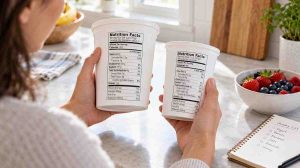
This is where the Nutrition Facts or Supplement Facts panel becomes essential.
Harvard’s Nutrition Source notes that processed and even ultra-processed products can differ substantially in nutritional quality and that processing classification alone does not fully describe their nutrient profile.
Start with serving size
Never compare protein powders by scoop count.
One company’s scoop may weigh much more than another company’s.
Compare using the labeled serving weight.
Check protein grams
Determine how much protein the serving actually provides.
Our guide to reading protein on nutrition labels explains why grams, serving size, and Percent Daily Value answer different questions.
Compare calories
Twenty-five grams of protein in 120 calories is a different product from 25 grams of protein in a 400-calorie meal-replacement formula.
Neither is automatically better.
They serve different purposes.
Check added sugars
A product marketed around protein can still contain meaningful amounts of added sugar.
Do not let the large protein number on the front make the rest of the label disappear.
Check sodium
Flavored and ready-to-drink products may contain enough sodium to make comparison worthwhile, especially if you consume them regularly.
Check fiber
Plant-based branding does not guarantee that a protein isolate contains substantial fiber.
Isolation can remove components found in the original whole food.
Use the number on the label.
A Useful Metric: Protein per 100 Calories
If your goal is primarily to obtain protein rather than replace an entire meal, one useful comparison is:
protein grams ÷ calories × 100
Example:
A powder contains:
25 g protein and 125 calories
25 ÷ 125 × 100 = 20 g protein per 100 calories
Another contains:
20 g protein and 200 calories
20 ÷ 200 × 100 = 10 g protein per 100 calories
This does not tell you which product is healthier.
It simply reveals which formula delivers protein more efficiently relative to calories.
Use it as a comparison tool, not a health score.
Nutrition Facts vs Supplement Facts
Protein products in the United States do not all use the same type of panel.
A dietary supplement is generally labeled with Supplement Facts, while conventional foods use Nutrition Facts.
FDA guidance also requires dietary supplements to disclose dietary ingredients and to list other ingredients such as fillers, stabilizers, preservatives, and flavors when applicable.
The practical lesson is:
the type of panel tells you something about how the product is marketed and regulated—not whether it is ultra-processed.
A Supplement Facts panel does not automatically mean:
“more processed.”
A Nutrition Facts panel does not automatically mean:
“less processed.”
You still need the ingredient list.
Three Hypothetical Protein Powders
Consider three imaginary products.
Product A: Plain Whey Concentrate
Ingredients:
Whey protein concentrate
Protein: 24 g
Calories: 130
Added sugar: 0 g
Processing assessment:
This is clearly processed and concentrated, but there are few obvious formulation ingredients to evaluate from the finished label alone.
Nutrition assessment:
High protein relative to calories and no added sugar.
Product B: Flavored Whey Isolate
Ingredients:
Whey protein isolate, cocoa, natural flavor, sucralose, lecithin, xanthan gum
Protein: 25 g
Calories: 120
Added sugar: 0 g
Processing assessment:
Much stronger NOVA Group 4 signals because the product combines isolated protein with flavoring, sweetener, emulsifying, and thickening ingredients.
Nutrition assessment:
Still provides a concentrated dose of protein with relatively few calories.
Those two statements can both be true.
Product C: Plant Protein Blend
Ingredients:
Pea protein, rice protein, flavor, guar gum, stevia extract, vitamin blend
Protein: 22 g
Calories: 150
Added sugar: 0 g
Processing assessment:
Also displays several characteristics of an industrially formulated product.
Nutrition assessment:
May be useful to someone who avoids dairy and wants supplemental protein.
The word “plant” does not cancel out the processing.
Does Ultra-Processed Mean Unhealthy?
This is the point where the discussion requires the most caution.
Research has repeatedly associated diets high in ultra-processed foods with poorer health outcomes.
In one important inpatient randomized controlled trial, researchers provided 20 adults with ultra-processed and unprocessed diets for two weeks each. Participants consumed roughly 500 more calories per day during the ultra-processed phase and gained weight.
That is meaningful evidence.
But it does not prove that adding one scoop of protein powder to an otherwise balanced diet produces the same effect.
The trial tested entire dietary patterns, not isolated protein powders.
This distinction matters.
Research also increasingly recognizes that foods within the UPF category are heterogeneous. A 2025 critical review argued that health associations differ between UPF subtypes and that processing classification alone can overlook meaningful differences in nutritional composition and purpose.
Harvard similarly notes that some ultra-processed products can still provide nutrients such as protein, fiber, calcium, and vitamins, even though a diet centered on minimally processed foods remains a useful general goal.
The Displacement Question Matters
Instead of asking only:
“Is this powder ultra-processed?”
ask:
“What is this powder replacing?”
Those are very different scenarios.
Scenario 1: Supplementing an otherwise balanced diet
Someone eats ordinary meals containing:
- vegetables;
- fruit;
- whole grains;
- beans;
- dairy or appropriate alternatives;
- meat, fish, eggs, or other protein sources;
and adds one protein shake because meeting protein needs is difficult after training.
The powder supplements the diet.
Scenario 2: Replacing most meals with formulated shakes
Someone gradually replaces breakfast, lunch, snacks, and sometimes dinner with packaged shakes and bars.
Now the issue is not merely the classification of one product.
It is dietary displacement.
Whole foods can provide:
- fiber;
- diverse micronutrients;
- plant compounds;
- different food structures;
- and eating experiences
that a protein isolate does not automatically reproduce.
The percentage of the diet coming from formulated products therefore matters.
What About Athletes?
Protein supplements can be convenient, but supplements should not be treated as automatically necessary.
The NIH Office of Dietary Supplements notes that an adequate diet and appropriate fluid intake remain foundational for exercise performance, while supplements may have specific roles depending on the person and product.
Athletes also have another concern unrelated to NOVA:
supplement quality control.
A product can have excellent macros and still be inappropriate for a drug-tested athlete if contamination risk is not adequately controlled.
That is a different evaluation axis from ultra-processing.
A 60-Second Protein Powder Label Test
Use this sequence in the store.
Step 1: Identify what type of product it is
Is it:
- basic protein powder;
- sports supplement;
- meal replacement;
- weight-gain powder;
- or ready-to-drink shake?
Do not compare products designed for completely different jobs.
Step 2: Find the actual protein source
Look for:
- whey concentrate;
- whey isolate;
- whey hydrolysate;
- casein;
- soy protein;
- pea protein;
- rice protein;
- egg protein;
- collagen;
- or a blend.
Step 3: Scan for formulation markers
Look for ingredients such as:
- flavors;
- sweeteners;
- gums;
- emulsifiers;
- stabilizers;
- colors;
- hydrolyzed ingredients;
- and multi-component premixes.
The more the product resembles an assembled formulation rather than a concentrated single ingredient, the stronger the case for an ultra-processed classification under NOVA.
Step 4: Read the nutrition panel
Check:
- serving size;
- protein;
- calories;
- added sugars;
- sodium;
- saturated fat;
- fiber where relevant.
For a more detailed purchasing framework, see what to look for in a protein shake.
Step 5: Calculate protein efficiency if useful
Compare protein per 100 calories or compare two products at an equal protein dose.
Do not compare one scoop with another scoop.
Step 6: Check allergens and tolerance
Whey and casein are milk-derived proteins.
Plant formulas may contain soy or other allergens.
Additional gums, fibers, or sweeteners may also affect digestive tolerance differently from person to person.
Step 7: Ask what role the product will play
Will it:
- supplement a meal?
- replace a snack?
- replace an entire meal?
- provide post-training protein?
- compensate for a restricted diet?
- or simply add calories you do not need?
That final question can be more important than whether the product lands in NOVA Group 3 or Group 4.
Common Mistakes When Judging Protein Powder
Mistake 1: Assuming “processed” means toxic
Processing describes what happened to food.
It does not itself demonstrate toxicity.
Mistake 2: Assuming every UPF has the same nutritional profile
A sugar-sweetened soft drink and a high-protein fortified shake can both be classified as highly formulated products while providing very different nutrients.
That does not erase concerns around heavy reliance on ultra-processed diets.
It means the category contains diverse foods.
Mistake 3: Counting ingredients instead of understanding them
A 12-ingredient product is not automatically worse than a 5-ingredient product.
Ask what the ingredients do.
Mistake 4: Assuming “natural flavor” makes a powder minimally processed
A marketing-friendly ingredient name does not reverse the industrial formulation used to create the finished product.
Mistake 5: Assuming plant protein is minimally processed
Plant protein isolates can also require extensive fractionation.
Mistake 6: Ignoring serving size
Two powders can advertise similar protein numbers while using very different serving weights.
Mistake 7: Treating protein powder as nutritionally complete
Protein powder is usually designed primarily to provide protein.
Unless the product is specifically formulated as a meal replacement, do not assume it replaces the full nutritional value of a balanced meal.
So, Should You Avoid Ultra-Processed Protein Powder?
Not automatically.
A useful decision depends on your diet, goals, health status, tolerance, and what the product replaces.
You might reasonably choose a simpler formula if two products meet the same need and one contains fewer formulation ingredients you do not want.
But it is equally possible for a more formulated product to solve a legitimate problem—for example:
- dairy avoidance;
- convenient protein intake;
- restricted appetite;
- athletic scheduling;
- travel;
- or difficulty reaching an appropriate protein intake with ordinary meals alone.
The label ultra-processed gives you information about processing.
It should start the evaluation.
It should not finish it.
When Protein Powder Deserves Extra Caution
General internet advice is not enough in every situation.
Discuss protein supplementation with an appropriate healthcare professional if you have:
- a medical condition requiring protein restriction;
- kidney or liver disease affecting dietary management;
- a diagnosed food allergy;
- unexplained reactions to supplements;
- pregnancy-related dietary concerns;
- or another clinician-directed nutrition plan.
Also remember that protein powders sold as dietary supplements are regulated differently from conventional foods in the United States. FDA does not approve dietary supplements for safety and effectiveness before they reach the market in the same way it approves drugs.
Frequently Asked Questions
Is whey protein isolate an ultra-processed food?
Many flavored whey isolate products display characteristics used by NOVA to identify ultra-processed foods, particularly when the isolate is combined with flavors, sweeteners, emulsifiers, or thickeners. A plain single-ingredient isolate is more difficult for consumers to classify confidently without applying a specific NOVA methodology.
Is whey protein concentrate less processed than isolate?
Whey concentrate generally retains more non-protein components than whey isolate because isolate undergoes additional purification to increase protein concentration. That does not automatically make concentrate the better product. Lactose tolerance, protein concentration, calories, formulation, and purpose still matter.
Is plant protein powder ultra-processed?
It can be. Plant-based protein powders commonly use concentrated or isolated pea, soy, rice, or other proteins. Flavored formulas with sweeteners, gums, emulsifiers, and additional ingredients can readily exhibit characteristics associated with ultra-processed formulations.
Is unflavored protein powder healthier?
Not necessarily. Unflavored products often contain fewer formulation ingredients, but healthfulness also depends on protein quantity, calories, allergens, the rest of your diet, and what the powder replaces.
Does a long ingredient list mean a protein powder is unhealthy?
No. Ingredient count alone is not a reliable health score. Identify the purpose of each ingredient and evaluate the nutrition panel alongside the list.
Are ready-to-drink protein shakes ultra-processed?
Many are heavily formulated and may fit NOVA Group 4 criteria, but products vary. Check the individual ingredient list rather than assuming every bottled protein drink is identical.
Can protein powder still fit a healthy diet?
For many healthy adults, protein powder can be a convenient supplemental source of protein. The broader dietary pattern remains important, and whole or minimally processed foods should not be displaced unnecessarily.
Bottom Line
So, is protein powder ultra processed?
For many commercial products, particularly flavored powders and ready-to-drink formulas containing isolated proteins plus flavors, sweeteners, emulsifiers, gums, or stabilizers, the answer under NOVA is often yes or strongly leans that way.
But that answer is only the first layer.
Processing classification does not tell you:
- whether the powder provides 10 or 30 grams of protein;
- whether it contains substantial added sugar;
- whether it fits your calorie needs;
- whether you tolerate its ingredients;
- whether it replaces a balanced meal;
- or whether it solves a legitimate nutrition problem.
The better method is the Two-Axis Protein Powder Test:
Axis 1: How extensively is the product processed and formulated?
Axis 2: What nutritional value and practical function does it actually provide?
Read both the ingredient list and the nutrition panel.
Then judge the product in the context of your entire diet—not from one word on a classification system.
Sources and References
Monteiro CA, et al. — “Ultra-processed foods: what they are and how to identify them.” Public Health Nutrition, 2019. The paper provides practical NOVA identification criteria, including characteristic ingredients and cosmetic additives.
Harvard T.H. Chan School of Public Health — Processed Foods and Health. Reviews food-processing categories, limitations of NOVA, and why nutritional quality still matters when evaluating processed foods.
Braesco V, et al. — “Ultra-processed foods: how functional is the NOVA system?” The study found relatively low overall agreement when evaluators classified some foods using NOVA criteria.
Hall KD, et al. — Ultra-Processed Diets Cause Excess Calorie Intake and Weight Gain. Randomized inpatient trial comparing ultra-processed and unprocessed dietary patterns.
U.S. Food and Drug Administration — Questions and Answers on Dietary Supplements and Dietary Supplement Labeling Guide. Explains Supplement Facts labeling, ingredient disclosure, and the regulatory definition of dietary supplements.
NIH Office of Dietary Supplements — Dietary Supplements for Exercise and Athletic Performance. Reviews the role and evidence for supplements used around exercise and sports performance.
Nutrition Note
This article is for general educational purposes and is not individualized medical or dietetic advice. People with medical conditions affecting protein intake, diagnosed food allergies, or clinician-prescribed dietary restrictions should follow individualized professional guidance.