
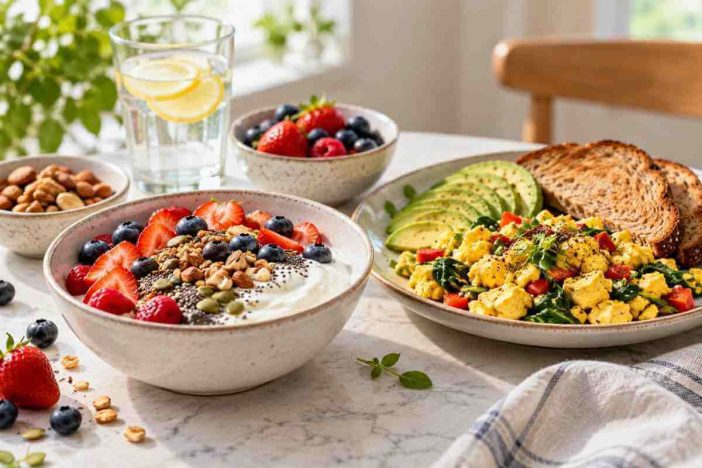
A bowl of cereal can look like breakfast. So can toast, oatmeal, fruit, or coffee grabbed on the way out the door. The problem appears an hour or two later, when what seemed like a meal turns out to have been mostly a delivery system for carbohydrates.
The usual fix is a scoop of protein powder.
It works. It is convenient. But it is not the only solution—and for someone who dislikes the taste, does not want another supplement in the pantry, or simply wants to rely more on ordinary food, it is not necessarily the most useful one.
A better question is not, “What high-protein breakfast should I eat?”
It is:
How can I build the breakfast I already like around enough protein-rich food to make it more substantial?
That shift turns breakfast from a collection of recipes into a repeatable skill.
What Makes a Breakfast “High Protein” in Real Life?
There is no universal protein number that every adult needs to hit at breakfast.
Protein needs vary with factors including body size, age, activity, overall energy intake, pregnancy, health status, and training goals. A number printed on a meal plan or promoted on social media should therefore not be treated as a personal prescription.
For packaged-food labeling in the United States, the FDA uses a Daily Value of 50 grams of protein. That is a reference value for nutrition labeling—not a personalized daily target.
This distinction matters.
Instead of chasing an arbitrary breakfast number, first look at the meal you normally eat. If breakfast contains little protein, the practical goal is to make protein a meaningful part of the meal rather than an incidental topping.
A breakfast of toast and fruit, for example, does not need to be abandoned. It needs an anchor.
That anchor might be Greek yogurt, cottage cheese, eggs, tofu, beans, milk, fortified soy milk, fish, or another protein-rich food that fits the way you eat.
The Protein Breakfast Builder
A useful high-protein breakfast without protein powder can be built in four decisions:
- Choose one protein anchor.
- Add a supporting protein source if needed.
- Add plants, whole grains, or other fiber-rich foods.
- Adjust the meal for your actual appetite and nutritional needs.
The order matters.
Many breakfasts are assembled in reverse: cereal first, fruit next, perhaps some seeds on top, and then an attempt to “add protein” at the end.
Starting with the protein anchor makes the meal easier to build.
Step 1: Choose the protein anchor
The anchor is the food doing most of the protein work.
Practical options include:
| Protein anchor | Works especially well in | What to check |
|---|---|---|
| Greek yogurt or skyr | Bowls, oats, parfaits | Compare protein and added sugar by brand |
| Cottage cheese | Toast, bowls, savory breakfasts | Sodium and serving size vary |
| Eggs | Toast, wraps, scrambles | Easy to combine with other foods |
| Tofu | Scrambles, wraps, savory bowls | Protein varies by firmness and brand |
| Tempeh | Hashes, sandwiches, bowls | Check sodium in seasoned versions |
| Dairy milk | Oatmeal, cereal, smoothies | Protein is easy to verify on the label |
| Fortified soy milk | Oats, cereal, smoothies | Often a stronger protein choice than many plant milks |
| Beans or lentils | Savory bowls, toast, breakfast tacos | Also contribute fiber |
| Fish or poultry leftovers | Toast, wraps, grain bowls | Useful when breakfast does not need to look “traditional” |
This is where food-first nutrition becomes easier: breakfast does not have to be made from breakfast foods.
Leftover lentils, tofu, chicken, salmon, or beans can solve a protein problem more efficiently than trying to turn every morning into another egg recipe.
Step 2: Add a supporting protein source
Once an anchor is present, smaller contributions begin to matter.
Oats, nuts, seeds, nut butter, whole-grain bread, cheese, and some higher-protein grains can increase the meal’s total protein while adding texture, energy, fiber, or micronutrients.
But there is an important distinction:
A protein contributor is not always a protein anchor.
A spoonful of peanut butter adds protein, but it also contains substantial fat and calories. Chia seeds contribute protein, but using enough chia to make it the meal’s primary protein source would create a very different breakfast.
That is why simply collecting foods that “contain protein” can be misleading.
Use the dense source as the anchor. Let the smaller sources support it.
Stop Guessing: Use the Label Math
Here is one of the most practical nutrition habits you can learn.
Turn the package around.
For packaged foods, check:
Protein per serving × the amount you actually eat
Do not compare products by front-of-package language such as “protein packed,” “made with protein,” or “power breakfast.”
Compare grams.
Suppose your breakfast contains three packaged foods:
- yogurt: 15 g protein in the portion you use
- cereal: 5 g
- milk: 8 g
That meal supplies about 28 g of protein based on those labels.
Change the milk, yogurt, cereal, or serving size and the result changes.
If two products use different serving sizes or show different protein claims, our guide to comparing protein on food labels explains how to interpret those numbers before adding them to your breakfast calculation.
This sounds obvious, yet it solves a major problem with online high-protein recipes: ingredient nutrition varies substantially among products.
The 60-Second Breakfast Protein Audit
Before buying special high-protein products, audit your normal breakfast.
Write down:
My usual breakfast:
Main protein source:
Protein shown on its label or reliable food database:
Other meaningful protein sources:
What could I swap rather than simply add?
That last question is important.
If breakfast is already large enough, adding yogurt, nuts, seeds, eggs, and nut butter on top may simply create a much bigger meal.
Often the smarter move is a swap.
Water in oatmeal → milk or fortified soy milk.
Low-protein plant beverage → a higher-protein alternative.
A mostly carbohydrate breakfast → keep part of it, but add or substitute a protein anchor.
A small yogurt used as a topping → make yogurt the base and use cereal as the topping.
This is meal design, not supplementation.
Seven Breakfast Structures You Can Rebuild Your Own Way
These are not prescriptions or rigid recipes. They are structures.
1. The yogurt bowl
Start with Greek yogurt or skyr.
Add fruit for flavor and fiber, then use oats, nuts, or seeds for texture.
The common mistake is reversing the proportions: a large amount of granola with two spoonfuls of yogurt.
If protein is the objective, make the yogurt the base.
2. The upgraded oatmeal bowl
Oatmeal provides some protein, but you do not have to make oats carry the entire meal.
Cook them with dairy milk or a higher-protein fortified soy beverage rather than water, then pair them with Greek yogurt, cottage cheese, nuts, seeds, or another food that suits your diet.
This approach is particularly useful if you already enjoy oatmeal and do not want breakfast to become a completely different meal.
3. Eggs plus a second source
Eggs are convenient, but breakfast does not have to become a contest to see how many eggs you can eat.
Pair a reasonable portion with another protein-containing food: dairy, beans, tofu, whole-grain toast, or leftovers.
The result can be more varied and nutritionally useful than relying on eggs alone.
4. The cottage cheese base
Cottage cheese works in both sweet and savory breakfasts.
Pair it with fruit and nuts, spread it on toast, or use it alongside tomatoes, vegetables, herbs, and whole grains.
If sodium matters for your diet, compare labels; products can differ.
5. The tofu breakfast
Tofu is not merely a substitute for scrambled eggs.
It can become the protein anchor in a vegetable scramble, breakfast wrap, grain bowl, or leftovers-based breakfast.
For people moving toward a more plant-forward eating pattern, tofu also provides a way to increase protein without turning every meal into beans and lentils.
6. The beans-for-breakfast approach
Breakfast traditions vary enormously around the world. Beans at breakfast are only unusual if your local breakfast culture says they are.
Beans can be paired with whole-grain toast, vegetables, avocado, salsa, eggs, or tofu.
They also bring something that many protein-focused meals overlook: fiber.
7. The leftovers breakfast
This may be the most underrated option.
If last night’s dinner contains a protein-rich food, there is no nutritional rule requiring you to ignore it until lunch.
A small grain bowl with leftover chicken and vegetables, lentils with toast, tofu and rice, or salmon with whole-grain bread can be a perfectly functional breakfast.
For busy mornings, the best breakfast may be the one that is already cooked.
What If You Do Not Eat Eggs?
Do not search for a perfect egg replacement. Replace the function of the eggs.
If eggs were your protein anchor, choose another anchor:
- Greek yogurt or skyr
- cottage cheese
- tofu
- tempeh
- beans or lentils
- dairy milk
- fortified soy milk
- fish or poultry, if those foods fit your diet
Then rebuild the rest of the breakfast around it.
This produces far more options than repeatedly searching for “egg-free breakfast recipes.”
What If You Avoid Dairy?
Dairy-free breakfast requires a little more label awareness because plant-based products are not nutritionally interchangeable.
A beverage can look and behave like milk in coffee or cereal while containing relatively little protein.
Check the Nutrition Facts panel rather than assuming that almond, oat, coconut, soy, pea-based, and other beverages provide similar amounts.
Soy foods, tofu, tempeh, beans, lentils, nuts, seeds, and appropriately chosen fortified products can all contribute to a dairy-free breakfast.
If your overall diet excludes several food groups, however, protein is only one part of the nutrition picture. Calcium, vitamin B12, vitamin D, iodine, iron, and other nutrients may deserve attention depending on the foods you avoid.
What If You Want a Plant-Based High-Protein Breakfast?
A plant-based breakfast becomes easier when you stop asking a single food to do everything.
Use a combination.
For example:
soy food + grain + seeds
or:
beans + whole grain + nuts/seeds
or:
tofu + vegetables + whole-grain toast
USDA’s Protein Foods group includes beans, peas, lentils, nuts, seeds, and soy products alongside animal protein foods. A varied plant-based diet can therefore draw protein from multiple ordinary food categories rather than depending on a powder.
The key is deliberate meal construction.
If you want to extend that approach beyond breakfast, our plant-based diet guide explains how foods such as tofu, tempeh, lentils, chickpeas, and other plant foods can fit into a broader eating pattern.
A fruit smoothie made with a low-protein plant beverage, for example, may be plant-based but still contain relatively little protein. Adding a meaningful soy food or another protein-rich ingredient changes the structure of the meal.
Protein Powder Is Not the Enemy
Choosing whole foods does not require turning protein powder into a villain.
Protein powder can be useful when convenience matters, appetite is limited, cooking is impractical, or someone’s nutritional requirements make concentrated protein helpful.
The mistake is treating powder as either essential or inherently inferior.
It is a tool.
If you already use shakes, understanding what goes into protein shakes can help you distinguish the protein source from sweeteners, flavorings, fiber, fats, vitamins, and other additions.
Likewise, knowing how much protein is actually in a protein shake is more useful than assuming that every scoop, bottle, or brand provides the same amount.
The food-first approach simply gives you another option: learn to construct the meal before deciding whether a supplement adds anything you actually need.
The Protein-Plus Test: Do Not Judge Breakfast by Protein Alone
A breakfast can contain plenty of protein and still be poorly constructed.
That is why protein works best inside a broader healthy eating framework, rather than becoming the sole measure of whether a meal is nutritious.
Before calling the meal finished, ask four questions.
1. Where is the protein anchor?
Can you point to the food doing most of the protein work?
If not, you may be adding together many small sources and calling the result high protein.
2. Where are the plants or fiber-rich foods?
Fruit, vegetables, beans, whole grains, nuts, and seeds can contribute fiber and a wider range of nutrients.
Protein should improve breakfast, not push every other food group off the plate.
3. Does this breakfast fit your morning?
A nutritionally impressive breakfast that takes 40 minutes to prepare is not practical if you have seven minutes before leaving home.
The sustainable version may be yogurt and fruit, overnight oats, leftovers, or a prepared tofu wrap.
4. Would you willingly eat it again?
This question is less trivial than it sounds.
A meal only becomes part of a dietary pattern when it is realistic enough to repeat.
Taste, cost, culture, convenience, and access are nutrition variables too.
A Better Grocery Strategy for Protein at Breakfast
Instead of shopping for “high-protein foods,” shop by role.
Choose:
One or two anchors
- Greek yogurt
- cottage cheese
- eggs
- tofu
- tempeh
- beans
- another protein-rich food appropriate for your diet
One liquid/base
- dairy milk
- fortified soy milk
- another option selected after checking its label
One whole-grain or fiber-rich carbohydrate
- oats
- whole-grain bread
- other minimally processed grains
Two or three plants
- berries
- bananas
- apples
- tomatoes
- greens
- peppers
- whatever produce you will actually eat
One texture/flavor addition
- nuts
- seeds
- nut or seed butter
- herbs
- spices
Now several breakfasts can come from the same grocery basket without requiring seven separate recipes.
That is usually more useful than buying ingredients for a “perfect” breakfast you make once.
Common Mistakes When Increasing Breakfast Protein
Mistake 1: Believing every “protein” product is protein-dense
Marketing language is not the same as nutritional composition.
Read the grams per serving.
Mistake 2: Adding instead of rebuilding
If you add several calorie-dense foods to an already complete breakfast simply because they contain protein, the meal may become much larger than intended.
Swap strategically.
Mistake 3: Ignoring the serving you actually eat
A package may show impressive numbers for a portion that is different from yours.
Do the simple serving math.
Mistake 4: Treating nuts and seeds like concentrated protein foods
They contribute protein and valuable nutrients, but they also supply substantial fat and energy.
They often work better as supporting players than as the sole protein anchor.
Mistake 5: Turning “high protein” into “protein only”
Fruit, vegetables, whole grains, legumes, nuts, and seeds bring nutrients that a protein target cannot replace.
The objective is a better breakfast—not the largest protein number possible.
When More Protein Is Not Automatically Better
Protein requirements are individual.
People with certain medical conditions, particularly those who have been given protein, potassium, phosphorus, fluid, or other dietary restrictions, should not use a general high-protein article as a personalized meal plan.
Pregnancy, older age, intensive athletic training, recovery from illness, gastrointestinal conditions, food allergies, and other circumstances can also change nutritional priorities.
If you have a medical condition or have been advised to modify protein intake, use guidance from your physician or registered dietitian rather than an internet protein target.
Your Five-Minute Breakfast Decision Framework
Tomorrow morning, do not start with a recipe.
Start with these five questions:
- What is my protein anchor?
- Do I need a second protein source, or is the anchor enough for this meal?
- Where is the fiber or plant food?
- Does the portion match my appetite and overall needs?
- Can I make this easily enough to repeat?
If those questions become automatic, you no longer need a list titled “50 high-protein breakfasts.”
You know how to build one.
Frequently Asked Questions
Can breakfast be high in protein without protein powder?
Yes. Foods such as Greek yogurt, cottage cheese, eggs, tofu, tempeh, beans, dairy milk, fortified soy milk, fish, poultry, nuts, and seeds can contribute protein. The practical approach is to choose one substantial protein anchor and build the rest of the meal around it.
Do I need 30 grams of protein at breakfast?
Not everyone needs the same amount of protein at breakfast. Individual requirements vary with age, body size, activity, health status, total diet, and other factors. Treat fixed numbers online as general examples rather than personalized targets.
How can I make oatmeal higher in protein without powder?
Instead of cooking oats only with water, consider a protein-containing milk or fortified soy beverage, then add a complementary source such as Greek yogurt, cottage cheese, nuts, or seeds. Check the labels of the ingredients you actually use because protein content varies among products.
Is a whole-food protein breakfast always better than a shake?
No. They solve different problems. Whole foods can provide protein alongside fiber, fats, carbohydrates, vitamins, and minerals, while shakes can offer convenience and concentrated protein. The more useful choice depends on your overall diet, schedule, preferences, appetite, and nutritional requirements.
Build the Meal, Not the Protein Number
A high-protein breakfast without protein powder does not require unusual ingredients, a bodybuilder’s meal plan, or the same eggs every morning.
It requires one transferable skill: identify the protein anchor first, then build a balanced meal around it.
Use labels when labels are available. Use reliable nutrition data for foods without them. Keep plants, fiber, practicality, and enjoyment in the picture.
And if protein powder genuinely makes your morning easier, there is no need to eliminate it simply to make breakfast more “natural.”
Food-first nutrition is not about proving that supplements are unnecessary.
It is about knowing how to feed yourself well even when the scoop is not there.