
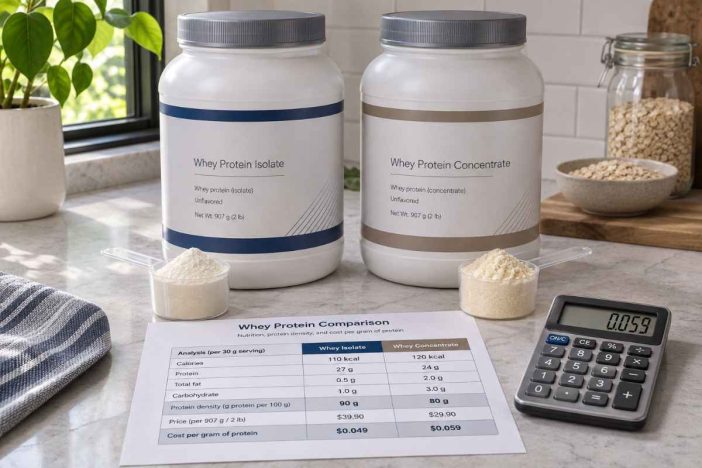
The decision usually happens in front of two tubs.
One says whey protein isolate and promises a high percentage of protein with very little carbohydrate or fat. The other says whey protein concentrate, provides almost the same protein per serving, and may cost noticeably less.
It is easy to assume that the more expensive, more filtered product must build more muscle.
That conclusion skips an important step.
The useful comparison is not simply isolate versus concentrate. It is whether the extra purification actually solves a problem for you: lactose tolerance, calorie control, protein density, serving size, or another practical constraint.
And before comparing scoops, you need to compare them fairly.
Quick Answer: Whey Protein Isolate vs Concentrate
Whey protein isolate is generally more highly purified and contains a higher proportion of protein with less lactose, carbohydrate, and fat than whey protein concentrate. Whey concentrate is usually less purified and may retain more lactose, fat, and other milk-derived components, but it can still provide high-quality complete protein.
Choose whey isolate when:
- minimizing lactose matters;
- you want maximum protein relative to serving weight;
- you need to limit carbohydrate or fat closely;
- or a particular isolate formula fits your digestion better.
Choose whey concentrate when:
- you tolerate dairy well;
- its slightly higher lactose, carbohydrate, and fat do not matter;
- you want to reduce cost;
- and it provides the protein amount you need.
For muscle building, do not assume isolate automatically produces better long-term results. Research directly comparing isolate and concentrate has not established a consistent performance or strength advantage for isolate when both provide substantial amounts of whey protein.
If you first need to understand where whey fits among other protein sources, see our whey protein vs plant protein comparison.
Whey Protein Isolate vs Concentrate at a Glance
| Factor | Whey Protein Isolate | Whey Protein Concentrate |
|---|---|---|
| Protein concentration | Generally higher | Generally lower |
| Typical high-protein form | Around 90%+ protein on a dry basis | WPC80 is around 80% protein; other concentrates can contain less |
| Lactose | Usually lower | Usually higher |
| Fat | Usually lower | Usually higher |
| Carbohydrate | Usually lower | Usually higher |
| Processing | More purification | Less purification |
| Milk-derived | Yes | Yes |
| Suitable for milk allergy | No | No |
| Best for lactose intolerance | Often easier to consider, but not automatically lactose-free | May contain more lactose |
| Calories at equal serving weight | Often slightly lower | May be slightly higher |
| Muscle-building protein quality | High | High |
| Price | Often higher | Often lower |
| Best choice | Depends on label and use case | Depends on label and use case |
The exact numbers vary by manufacturer, flavor, and formulation. Always use the current product label rather than assuming every isolate or concentrate has identical macros.
What Are Whey Protein Concentrate and Whey Protein Isolate?
Both start with whey, the liquid portion separated during cheese or dairy processing.
Manufacturers then remove varying amounts of water and non-protein components.
The degree of separation determines whether the final ingredient is a concentrate, isolate, or another whey product.
Whey protein concentrate
Whey protein concentrate (WPC) is made by removing some non-protein components from whey.
The term covers products with different protein concentrations. Commercial sports powders commonly use high-protein concentrate such as WPC80, but the word “concentrate” itself does not guarantee exactly 80% protein.
WPC generally retains more:
- lactose;
- fat;
- carbohydrate;
- minerals;
- and other whey constituents
than a highly purified isolate.
If you want a broader explanation of the ingredients that can appear around the protein itself, see what is in a protein shake.
Whey protein isolate
Whey protein isolate (WPI) undergoes additional separation to remove more lactose, fat, and other non-protein material.
WPI is generally expected to contain about 90% or more protein on a dry-weight basis, although the finished flavored protein powder you buy will also contain moisture and potentially flavoring, sweeteners, emulsifiers, or other ingredients.
That means a tub containing WPI is not automatically “90% protein” by total retail product weight.
Always read the actual serving information.
7 Key Differences Between Whey Isolate and Concentrate
1. Isolate usually has greater protein density
This is the most meaningful compositional difference.
Imagine two hypothetical labels:
Product A — Concentrate
Serving size: 30 g
Protein: 24 g
Product B — Isolate
Serving size: 28 g
Protein: 25 g
Both provide a useful amount of protein.
But Product B delivers slightly more protein from a smaller quantity of powder.
A simple way to compare them is:
Protein density = protein grams ÷ serving weight × 100
Product A:
24 ÷ 30 × 100 = 80%
Product B:
25 ÷ 28 × 100 = 89.3%
This metric tells you how much of the serving weight is represented by labeled protein.
It does not tell you which product is healthier or which will build more muscle.
If you frequently compare protein numbers on packages, our guide to reading protein on nutrition labels explains why serving size must be normalized before comparing products.
2. Isolate generally contains less lactose
Additional filtration removes more of the lactose-containing portion of whey.
As a result, isolate commonly contains less lactose than concentrate.
This can matter for people with lactose intolerance.
But two cautions are essential.
First, lower lactose does not mean automatically lactose-free.
Products vary.
Second, lactose intolerance is not the same as milk allergy.
Someone with lactose intolerance has difficulty digesting lactose. Tolerance also varies considerably between individuals.
Someone with a milk allergy reacts to milk proteins.
Both whey isolate and concentrate are milk-derived proteins, so choosing isolate does not turn whey into a dairy-free protein.
Check the allergen declaration.
3. Isolate usually contains less fat and carbohydrate
Further purification generally removes more non-protein components.
This commonly produces a label with:
- slightly less carbohydrate;
- less lactose;
- less fat;
- and a higher percentage of protein.
That sounds impressive, but ask whether the difference matters in the context of your entire diet.
Suppose one product contains:
120 calories and 25 g protein
and another:
130 calories and 24 g protein
There is a measurable difference.
But a 10-calorie difference is unlikely to transform a weight-management plan by itself.
The better question is whether the overall label fits your actual calorie and nutrient targets.
For goal-specific selection, see our guide to choosing protein powder for weight loss.
4. Isolate does not automatically build more muscle
This is where marketing can get ahead of evidence.
Both WPI and high-protein WPC provide whey protein containing all essential amino acids.
A direct six-week training study comparing whey isolate and whey concentrate found no differential effect on performance, cardiorespiratory fitness, or upper- and lower-body strength adaptations between the whey groups.
That study was relatively small and does not prove that the products are identical in every situation.
But it does challenge the simplistic claim:
“Isolate is purer, therefore isolate builds more muscle.”
Protein purity and long-term training results are different questions.
For most people trying to build or preserve muscle, bigger variables include:
- adequate total protein intake;
- an appropriate training program;
- energy intake;
- sufficient recovery;
- and consistency.
If two products provide similar amounts of whey protein and you tolerate both, the difference between WPI and WPC may matter less than the label suggests.
5. Concentrate is less purified, but that does not automatically make it healthier
Isolate requires additional processing to reduce non-protein components.
Therefore:
isolate = more purified
and
concentrate = less purified
are fair descriptions.
But do not turn that into:
less processed = automatically healthier
or
more purified = automatically better.
Processing changes composition.
Whether that difference benefits you depends on why you are using the product.
If you are interested in processing classification rather than merely purification, our guide to whether protein powder is ultra-processed explains why the finished formulation matters as much as the protein ingredient.
A plain whey isolate and a chocolate-flavored isolate containing sweeteners, gums, emulsifiers, and flavor systems are not identical products just because both use WPI.
The same applies to concentrate.
6. Concentrate is often more economical
Price is one of the strongest practical reasons to choose concentrate.
But comparing the sticker price of two tubs can be misleading.
A cheaper package may:
- contain less total protein;
- have fewer servings;
- require larger servings;
- or contain a lower proportion of protein.
Use cost per equal amount of protein instead.
The Cost-per-25-g-Protein Formula
First calculate total protein in the package:
protein per serving × servings per container
Then calculate:
package price ÷ total grams of protein × 25
That gives an approximate cost per 25 g of labeled protein.
For example, imagine:
Product A costs $30 and contains 600 g total protein.
$30 ÷ 600 × 25 = $1.25 per 25 g protein
Product B costs $40 and contains 750 g total protein.
$40 ÷ 750 × 25 = $1.33 per 25 g protein
Product B might look more protein-dense, yet Product A is cheaper at an equivalent protein dose.
These are hypothetical examples, not current product prices.
7. The best choice depends on the constraint you actually have
The difference between isolate and concentrate becomes clearer when you stop asking:
“Which is better?”
and ask:
“What problem am I trying to solve?”
If you have no relevant problem, paying more for isolate may not provide a meaningful advantage.
The Equal-Protein Rule
This is the most important comparison rule in this article.
Never compare one scoop of isolate with one scoop of concentrate unless the scoops contain the same amount of protein.
Scoop sizes are arbitrary.
Manufacturer A might use 28 g.
Manufacturer B might use 34 g.
Manufacturer C could make the scoop look enormous while delivering the same amount of protein.
Instead, normalize the comparison.
For example:
Product A requires 31 g powder to provide 25 g protein.
Product B requires 28 g powder to provide 25 g protein.
Then compare:
- calories;
- carbohydrate;
- fat;
- lactose considerations;
- sodium;
- added ingredients;
- cost;
- and tolerance
at approximately the same protein dose.
This removes much of the marketing noise.
Which Is Better for Muscle Gain?
For most healthy adults who tolerate both products, either can be a practical whey protein source.
Isolate may be attractive because it provides more protein relative to powder weight.
But that does not mean an equal protein dose of concentrate becomes ineffective.
A better muscle-gain decision is:
- Can the product help you meet your protein needs?
- Do you tolerate it?
- Can you afford to use it consistently?
- Does it fit your calorie intake?
- Does the label contain unnecessary extras for your purpose?
If both pass those tests, the distinction between WPI and WPC may be relatively small.
For a broader overview of whey itself, read protein in whey protein shakes.
Which Is Better for Weight Loss?
Neither whey isolate nor concentrate directly causes fat loss.
Weight change depends primarily on the broader energy balance and dietary pattern.
Isolate can make sense when:
- you want a high protein-to-calorie ratio;
- every few grams of carbohydrate or fat matter to your dietary plan;
- or the isolate product simply has a leaner label.
But do the calculation first.
A concentrate providing nearly the same protein and only a small calorie difference may still fit perfectly well.
Do not pay a large premium to save a trivial number of calories unless that difference has a real purpose.
Which Is Better for Lactose Intolerance?
Whey isolate is generally the more logical form to investigate first because it typically contains less lactose.
But it should not be described as universally lactose-free.
Lactose tolerance varies.
Formulations vary.
Some products may also include additional milk-derived ingredients.
If lactose is a significant concern:
- read the complete ingredient list;
- check whether the manufacturer provides lactose information;
- do not assume the word “isolate” guarantees zero lactose;
- consider a genuinely dairy-free protein if necessary.
What If You Have a Milk Allergy?
This is different from lactose intolerance.
Do not choose whey isolate as a workaround for a diagnosed milk allergy.
Whey is a milk protein.
FDA allergen-label guidance explicitly treats whey protein isolate as a milk-derived allergen that must be appropriately declared.
If you have a diagnosed milk allergy, use the guidance given by your healthcare professional and choose an appropriate non-milk protein source when advised.
Which Is Better for Sensitive Digestion?
There is no universal answer.
Isolate may be better tolerated by someone whose symptoms are driven primarily by lactose.
But digestive symptoms can also come from:
- sweeteners;
- sugar alcohols;
- gums;
- added fibers;
- flavor systems;
- large serving sizes;
- or other ingredients.
That means switching from concentrate to a heavily flavored isolate may not solve the real problem.
Compare the entire formulation, not just WPI versus WPC.
Is Isolate Better for Athletes?
Not automatically.
An athlete may value isolate because:
- it is protein-dense;
- it can be low in carbohydrate and fat;
- it may fit tightly controlled nutrition plans.
But athletes—especially those subject to drug testing—also need to consider something unrelated to WPI versus WPC:
supplement quality assurance.
The protein form does not tell you whether the finished supplement has undergone independent testing for contaminants or prohibited substances.
If certification matters to your sport, verify the current certification for the exact product and flavor rather than assuming the entire brand is covered.
Is Whey Concentrate Better Because It Is Less Processed?
Not necessarily.
Concentrate retains more of the non-protein material present in whey.
Some consumers prefer that.
Others specifically want the lower lactose, lower fat, or greater protein density that comes with further purification.
There is no evidence-based rule saying:
more purification = unhealthy
or
less purification = healthier.
Evaluate processing and nutrition as separate questions.
A 60-Second Whey Buying Decision Framework
Use this sequence when comparing two tubs.
Step 1: Check the exact protein form
Look for:
- whey protein concentrate;
- whey protein isolate;
- whey protein hydrolysate;
- or a blend.
A front label saying “100% whey” does not necessarily mean the powder contains one form of whey.
Step 2: Check protein per serving
Record the number of grams.
Do not stop there.
Step 3: Check serving weight
Now calculate:
protein grams ÷ serving grams × 100
This gives protein density.
Step 4: Normalize to the same protein dose
Compare what each powder provides at approximately 25 g protein, rather than one scoop versus one scoop.
Step 5: Compare calories and macros
Check:
- calories;
- total carbohydrate;
- fat;
- added sugar;
- and sodium.
Decide whether the differences are materially important to your diet.
Step 6: Evaluate lactose and allergen needs separately
Remember:
lactose intolerance ≠ milk allergy.
WPI may contain less lactose, but both WPI and WPC are milk-derived.
Step 7: Read the rest of the ingredient list
The protein ingredient is only one part of a flavored product.
Check for:
- sweeteners;
- gums;
- flavorings;
- emulsifiers;
- added vitamins;
- digestive enzymes;
- or other ingredients relevant to you.
Step 8: Calculate cost per equal protein dose
Use cost per 25 g protein, not tub price.
Step 9: Choose the product that solves a real constraint
That may be:
- isolate for lower lactose;
- isolate for greater protein density;
- concentrate for lower cost;
- or simply whichever well-formulated product you tolerate and will use consistently.
Decision Tree: Isolate or Concentrate?
Start here:
Do you have a diagnosed milk allergy?
Yes → Neither whey isolate nor concentrate should be treated as a dairy-free option. Follow appropriate allergy guidance.
No → Continue.
Does lactose commonly cause symptoms for you?
Yes → Investigate a low-lactose isolate and verify the individual product.
No → Continue.
Do you need the lowest practical carbohydrate and fat for a tightly controlled diet?
Yes → Isolate may offer a practical advantage.
No → Continue.
Does concentrate provide the same useful protein dose for substantially less money?
Yes → Concentrate may be the better value.
No → Compare the complete label, taste, tolerance, certification needs, and cost per equal protein dose.
That is a more defensible decision than simply buying whichever tub says “premium isolate.”
Common Whey Isolate vs Concentrate Mistakes
Mistake 1: Assuming isolate always builds more muscle
More protein percentage in the powder does not automatically mean more muscle growth when total protein intake is equivalent.
Mistake 2: Comparing scoops rather than protein doses
Scoops vary in size.
Normalize the comparison.
Mistake 3: Calling isolate dairy-free
It is not.
Whey isolate remains derived from milk.
Mistake 4: Calling every isolate lactose-free
Isolate is generally lower in lactose, but the exact amount and finished formulation vary.
Mistake 5: Comparing tub prices
Calculate cost per equal amount of protein.
Mistake 6: Ignoring the rest of the formula
An isolate can still contain numerous flavoring and formulation ingredients.
A concentrate can be very simple.
Mistake 7: Assuming “more processed” means worse
Additional purification changes the macronutrient composition. It does not by itself establish that the product is nutritionally inferior.
Frequently Asked Questions
Is whey isolate better than concentrate?
Not universally. Isolate generally contains more protein relative to its weight and less lactose, carbohydrate, and fat. Concentrate can provide the same core whey proteins at lower cost. The better choice depends on tolerance, macros, budget, and the exact product.
Is whey isolate better for muscle gain?
There is no strong basis for assuming isolate automatically produces better muscle or strength outcomes than concentrate when comparable amounts of high-quality whey protein are consumed. Training, total protein intake, energy intake, and consistency matter substantially.
Does whey concentrate contain lactose?
Yes, whey concentrate can contain lactose. The amount varies with the concentration and manufacturing process.
Is whey isolate lactose-free?
Not necessarily. It generally contains less lactose than concentrate, but consumers who need to avoid lactose should verify the exact product rather than relying on the word “isolate.”
Can someone with a milk allergy use whey isolate?
Whey isolate is still a milk-derived protein and should not be treated as an allergy-safe dairy substitute.
Is whey concentrate healthier because it is less processed?
There is no universal basis for that conclusion. Concentrate and isolate differ in purification and composition. Processing level should not substitute for evaluating the actual label and dietary context.
Why is whey isolate more expensive?
Additional purification is generally required to remove more non-protein material and produce a higher proportion of protein. Manufacturing, brand, certification, formulation, package size, and retail pricing also affect the final price.
Can I mix whey isolate and concentrate?
Yes. Many commercial whey products already use blends. What matters is the finished product’s protein amount, formulation, allergens, tolerance, and suitability for your goal.
Bottom Line
The whey protein isolate vs concentrate decision does not need a universal winner.
Isolate generally gives you:
- higher protein density;
- less lactose;
- less carbohydrate and fat;
- and often a leaner macro profile.
Concentrate generally gives you:
- high-quality whey protein;
- less extensive purification;
- and often better value.
What isolate does not automatically give you is superior muscle growth, better health, or a better product.
Use three rules:
Compare equal protein, not equal scoops.
Separate lactose intolerance from milk allergy.
Calculate cost per equal protein dose before paying for purity you may not need.
If two products deliver similar protein, you tolerate both, and the macro differences are trivial for your diet, concentrate may be entirely sufficient.
If lower lactose or maximum protein density solves a real constraint, isolate may justify the premium.
The best whey protein is therefore not the one with the most impressive purification claim.
It is the one whose differences actually matter to you.
Sources and References
- U.S. Department of Agriculture. Whey Protein Concentrate Specifications. Defines WPC as whey from which sufficient non-protein constituents have been removed and describes physical separation methods used in production.
- Forbes SC, Bell GJ. Whey protein isolate or concentrate combined with concurrent training does not augment performance, cardiorespiratory fitness, or strength adaptations. Journal of Sports Medicine and Physical Fitness. 2020;60(6):832–840. PMID: 32141277.
- NIDDK, National Institutes of Health. Eating, Diet, & Nutrition for Lactose Intolerance. Explains individual differences in lactose tolerance and identifies whey and protein powders among potential dietary sources of lactose.
- U.S. Food and Drug Administration. Questions and Answers Regarding Food Allergens and Food Allergen Labeling Requirements. FDA labeling examples explicitly identify whey protein isolate as milk-derived.
- Naclerio F, Larumbe-Zabala E, et al. Comparative research and systematic evidence examining concentrated, isolated, and hydrolyzed whey supplementation and body-composition outcomes.
- Dairy-science literature on whey protein ingredients. High-protein whey concentrates such as WPC80 contain a greater proportion of lactose, fat, and other solids than whey protein isolates, which undergo further purification to reach roughly 90% or more protein on a dry basis.
Nutrition Note
This article provides general nutrition education and does not replace individualized medical or dietetic advice. People with diagnosed milk allergy, significant gastrointestinal symptoms, kidney disease, or another condition requiring individualized protein management should follow guidance from an appropriate healthcare professional.