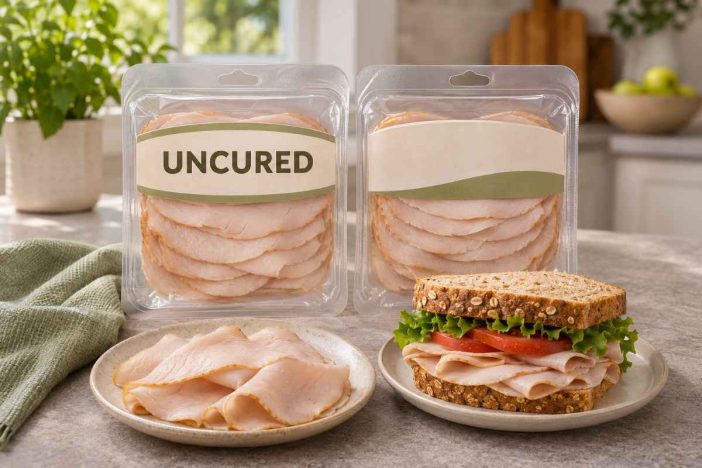
A shopper reaches for a package of sliced turkey labeled “uncured.” A second package advertises “no nitrates or nitrites added.” A third says “organic.”
All three look like reasonable sandwich options. The claims suggest different standards, but none answers the most important question: How was the meat preserved?
That matters because “uncured” is a labeling term with a specific regulatory meaning. It is not the same as “unprocessed,” and it does not establish that a product is healthier than conventional deli meat.
The useful information is usually found in three places: the product name, the ingredient list, and the Nutrition Facts panel.
Is Uncured Deli Meat Processed?
Yes, many uncured deli meats are still processed meats. Products that have been salted, preserved, smoked, fermented, or treated with other preservation methods can meet the definition of processed meat even if their labels say “uncured.”
The World Health Organization’s International Agency for Research on Cancer (IARC) defines processed meat by the methods used to transform it for preservation or flavor.
Those methods include salting, curing, fermentation, and smoking.
This definition does not depend solely on whether a manufacturer adds synthetic sodium nitrite.
An uncured turkey product containing celery-derived nitrate or nitrite may still be preserved in a way similar to conventional cured deli meat.
The same principle applies to certain uncured hams, bacon products, and hot dogs.
But not every piece of cooked or sliced meat is automatically processed meat in this health-risk classification.
The distinction is preservation method versus ordinary food preparation.
If you roast a fresh turkey breast at home and slice it for sandwiches, that is different from buying a commercially preserved turkey cold cut.
For a broader explanation of food categories, see our processed meat list and definition guide.
What Does “Uncured” Actually Mean on a U.S. Meat Label?
In everyday language, “uncured” sounds as though no curing or preservation has taken place.
On certain U.S. meat products, however, the term has a narrower meaning.
Federal labeling rules permit qualifying products to use “uncured” when they are made without the conventional nitrate or nitrite curing agents addressed by the regulation.
Some of those products use ingredients that naturally supply nitrate or nitrite, such as celery-derived ingredients.
That creates an important distinction:
A product can be labeled “uncured” while still containing nitrate or nitrite from natural sources.
The precise labeling requirements depend on the product and formulation. They should not be generalized to every food containing the word uncured.
USDA’s Food Safety and Inspection Service (FSIS) provides relevant guidance, and the regulatory language is set out in 9 CFR § 317.17.
Why Celery Powder Appears in Uncured Deli Meat
Celery contains naturally occurring nitrate.
In certain meat formulations, celery powder or cultured celery ingredients can supply nitrate or nitrite that contributes to effects associated with curing and preservation.
This is why an ingredient that sounds like an ordinary vegetable can have a technical role in a meat product.
The important point is not that celery itself is dangerous.
Celery eaten as a vegetable is not equivalent to a processed-meat formulation containing concentrated celery-derived ingredients.
It would also be inaccurate to say that every product containing celery powder necessarily has the same nitrate concentration or health effects.
The actual formulation matters.
What “No Nitrates or Nitrites Added” Can Mean
This phrase needs careful reading.
Some U.S. meat packages carry a statement indicating no nitrate or nitrite was added, followed by a qualifying statement identifying naturally occurring sources, such as celery powder.
The complete claim matters more than the headline printed in large letters.
For example, a package might state:
“No nitrates or nitrites added, except those naturally occurring in celery powder.”
This wording does not mean that nitrate and nitrite are entirely absent from the finished food.
It identifies a distinction in the sources used by the manufacturer.
Do not assume the phrase means the product is nitrate-free in a chemical sense or that it has been proven to carry a lower long-term health risk.
How to Read an Uncured Deli Meat Label in Five Steps
A practical label check is more useful than deciding based on one marketing phrase.
Step 1: Identify the Meat and Product Type
Start with the complete product name.
Is it turkey breast, ham, roast beef, chicken, salami, or another meat?
Then look for descriptions such as:
- Smoked
- Cured or uncured
- Salted
- Fermented
- Ready-to-eat lunch meat
- Oven-roasted
These words can provide clues, but they do not all have identical meanings.
“Oven-roasted,” for example, describes a cooking method. By itself, it does not establish whether the meat was preserved through another process.
Step 2: Read the Full Nitrate or Nitrite Claim
Look beyond any large “no nitrates added” statement.
Check whether the package also mentions naturally occurring nitrate or nitrite sources.
Read the entire qualifying statement rather than just the most prominent words.
If the statement is confusing or absent, do not infer the product’s exact nitrate concentration from marketing language.
Step 3: Examine the Ingredient List
Ingredients worth recognizing include:
- Sodium nitrite or sodium nitrate
- Potassium nitrite or potassium nitrate
- Celery powder, cultured celery powder, or celery juice powder
- Salt and other ingredients used in the formulation
- Other ingredients that may contribute to preservation or texture
An ingredient’s name can provide a clue, but it does not tell you precisely how much nitrate or nitrite is present.
Nor does the absence of one ingredient prove that the product has not undergone another preservation process.
Step 4: Compare Sodium per Serving
Even when two deli meats differ in their curing methods, both may contain substantial sodium.
Use the Nutrition Facts panel to compare products based on equivalent quantities.
The U.S. Food and Drug Administration lists a sodium Daily Value of 2,300 milligrams for adults and children age four and older.
As a general labeling guide, 5% Daily Value or less is considered low, while 20% or more is considered high.
These percentages refer to the nutrient contribution of one labeled serving, not whether the meat is processed.
For detailed guidance, consult the FDA’s Sodium in Your Diet resource.
Step 5: Check How the Product Must Be Stored and Handled
Ready-to-eat sliced meats are perishable foods.
An “uncured” label is not permission to keep the product unrefrigerated or ignore package directions.
Follow the product’s refrigeration instructions, use-by information, and applicable food-safety guidance.
Some products have additional required handling statements under USDA regulations.
If a product claims to be shelf-stable, verify that its packaging and manufacturer instructions support that use.
Three Deli Meat Labels Compared: What Would You Conclude?
Imagine three fictional products in a supermarket refrigerator.
The examples below are educational illustrations, not actual products or laboratory analyses.
| Product | Front-label claim | Ingredients or processing clues | Reasonable interpretation |
|---|---|---|---|
| A: Sliced turkey | “Uncured” and “No nitrates or nitrites added” | Cultured celery powder and salt; preserved deli formulation | The claim does not establish that the meat is unprocessed |
| B: Smoked ham | “Naturally smoked” | Smoking and curing information | Smoking or curing can place it within the processed-meat category |
| C: Home-roasted turkey | No packaged deli-meat claim | Fresh turkey roasted and sliced at home, without curing or smoking for preservation | Ordinary cooking and slicing alone do not establish processed-meat classification |
The third example is not presented as a guarantee of superior nutrition or food safety.
Freshly prepared turkey still requires safe handling, appropriate cooking, and refrigeration.
The comparison demonstrates why the process matters more than the label’s visual impression.
The Two-Question Classification Test
When you encounter an unfamiliar product, ask:
Question 1: Was the meat altered through curing, preservation-focused salting, smoking, fermentation, or a comparable process?
If yes, it may fall within the processed-meat category used in health research.
Question 2: Is the label emphasizing an ingredient claim rather than the actual preservation method?
If yes, look beyond the claim.
A product can use fewer conventional additives and still be processed meat.
This is a classification framework, not an official government certification test or a substitute for detailed manufacturing information.
If the package does not make the method clear, the manufacturer may be the only source that can confirm it.
Does Nitrate-Free Deli Meat Have Less Cancer Risk?
This is where a straightforward label-reading question becomes a health-evidence question.
There is not sufficient evidence to conclude that choosing an uncured or nitrate-free processed meat eliminates the colorectal cancer risk associated with processed meat consumption.
IARC has classified processed meat consumption as carcinogenic to humans based on sufficient evidence linking it to colorectal cancer.
That classification addresses the strength of the evidence establishing a carcinogenic hazard. It does not mean eating a slice of deli turkey carries the same level of risk as smoking, or that one serving will cause cancer.
Researchers continue to investigate the roles of curing compounds, other preservation methods, cooking, and dietary patterns.
The American Institute for Cancer Research recommends eating little, if any, processed meat.
Its guidance does not treat natural-source curing ingredients as proof that a processed-meat product is risk-free.
Natural Nitrates Are Not the Same as Eating Vegetables
Vegetables and processed meats are very different food matrices.
Vegetables can provide fiber, vitamins, and other compounds that are not present in the same combination or amounts in preserved meat.
It would therefore be misleading to equate a serving of celery with a processed meat containing concentrated celery-derived ingredients.
It would be equally misleading to conclude that every food containing naturally occurring nitrate is harmful.
The entire food and its preparation matter.
Why “Uncured” Is Not a Health Guarantee
A package can accurately use a permitted labeling term without answering every nutrition or health question.
An uncured deli meat may still be:
- Preserved using salt or other ingredients
- A source of substantial sodium
- Made from meat that has undergone several processing steps
- Intended to be eaten as a ready-to-eat refrigerated food
Its label does not establish that it has been shown to reduce cancer risk compared with another preserved deli meat.
If you are choosing it for flavor or an ingredient preference, that is a different decision from choosing it because you believe it eliminates processed-meat risk.
Organic, Natural, and Minimally Processed: Three Different Claims
The words sound related, but they address different characteristics.
Organic Refers to Production Standards
USDA Organic labeling concerns regulated agricultural production and handling practices.
It does not automatically mean a meat product is free from processing or preservation.
An organic deli meat can still be processed meat.
Natural Does Not Mean Unprocessed
The term “natural” on meat labels has a specific regulatory context.
It does not mean a food was never salted, preserved, packaged, or otherwise processed.
Treat the claim as one piece of product information rather than a complete nutrition assessment.
Minimally Processed Is Not the Same as Freshly Prepared
A product described as minimally processed may have undergone less processing than another product, but that phrase alone does not establish whether curing or preservation methods were used.
A minimally processed claim also does not guarantee low sodium, low saturated fat, or reduced long-term disease risk.
For these reasons, marketing terms should not replace a review of the full product label.
Is Uncured Turkey Different From Uncured Ham?
The animal source changes the meat’s nutrient composition, but it does not erase the importance of preservation.
Turkey is poultry. Ham is generally made from pork, which is classified as red meat in nutrition research.
However, poultry can also become processed meat when it undergoes relevant preservation methods.
A smoked or cured turkey product should not automatically be classified as unprocessed simply because it comes from a bird.
This distinction is explained further in our guide to what counts as red meat.
There may be meaningful differences between products in sodium, fat, protein, and other nutrients.
Compare those characteristics directly rather than assuming the poultry version must be unprocessed or the pork version must always have the same formulation.
A Better Sandwich-Meat Decision
For someone who makes sandwiches regularly, the most useful decision may not be which processed meat has the most reassuring front label.
It may be whether every sandwich needs packaged cold cuts.
Consider the following options.
When Convenience Is the Priority
Choose a product whose ingredients and nutrition information you understand.
Compare sodium using similar serving sizes.
Follow storage instructions and use the food within the recommended period.
If it is a preserved deli product, treat it as processed meat even if it uses an uncured labeling convention.
When You Want to Reduce Processed Meat
Consider freshly cooked chicken or turkey, sliced after cooking, for some meals.
Other sandwich fillings can include eggs, hummus, bean spreads, tofu, or combinations of vegetables and other protein sources.
The best replacement is one you can prepare safely and use consistently.
For additional ideas, see our guide to processed meat alternatives.
When You Want to Compare Two Packaged Options
Do not judge them by the words “natural” and “uncured” alone.
Use a consistent comparison:
| Check | What to compare | What it tells you |
|---|---|---|
| Preservation method | Curing, smoking, salting, fermentation | Whether the processed-meat definition may apply |
| Curing ingredients | Conventional or naturally derived sources | How the product is formulated |
| Sodium | Milligrams for equivalent quantities | Relative sodium contribution |
| Saturated fat | Grams for equivalent quantities | Another nutrition consideration |
| Storage requirements | Refrigeration and handling instructions | How to handle the food safely |
| Frequency | How often the food appears in your diet | Whether it is an occasional or routine choice |
This is a more useful comparison than declaring one product “healthy” because its packaging contains fewer chemical-sounding words.
Four Common Mistakes When Reading Uncured Meat Labels
The most common errors involve assumptions the label does not actually support.
Mistake 1: Treating “No Nitrates Added” as Zero Nitrates
A complete U.S. claim may identify naturally occurring nitrate or nitrite sources.
Read the qualifying language and ingredient list.
Mistake 2: Assuming Celery Powder Makes a Product Equivalent to Fresh Celery
An ingredient can have a technical function in a processed-food formulation.
A preserved meat product is not nutritionally equivalent to the vegetable from which one ingredient originated.
Mistake 3: Assuming Organic Meat Cannot Be Processed Meat
Organic production standards and processed-meat classification answer different questions.
A product can meet organic standards while also being cured or otherwise preserved.
Mistake 4: Using Sodium as the Only Test
Sodium is worth comparing, but it does not establish whether a meat is processed.
A lower-sodium processed meat can still be processed meat.
Likewise, fresh meat seasoned with salt during ordinary home cooking does not automatically become equivalent to an industrially preserved cold cut.
When the Label Does Not Tell You Enough
Sometimes the package does not clearly explain why a product lasts as long as it does.
An ingredient list may not disclose every technical detail of the processing method.
If the distinction materially affects your buying decision, contact the manufacturer and ask how the meat is preserved.
For general dietary decisions, use recognized public-health guidance rather than interpreting an unclear marketing claim as proof of reduced risk.
People managing high blood pressure, kidney disease, or another condition requiring individualized sodium restrictions should follow guidance from their healthcare professional or registered dietitian.
Those needs cannot be resolved by the word “uncured” alone.
Frequently Asked Questions
Is uncured turkey breast considered processed meat?
It can be. If the turkey is cured, smoked, salted for preservation, or processed using comparable methods, it may meet the processed-meat definition even when labeled uncured. Fresh turkey breast cooked and sliced at home is different. The product’s preparation and preservation method determine the distinction.
Does celery powder mean nitrates or nitrites are present?
Celery-derived ingredients can provide naturally occurring nitrate or nitrite in certain meat formulations. Their presence does not reveal the exact concentration in the finished product. Check the complete label and any qualifying statement, and avoid assuming that naturally sourced ingredients guarantee a lower-risk processed meat.
Is organic uncured deli meat healthier than regular deli meat?
An organic or uncured claim alone cannot establish that one deli meat is healthier. The products may differ in ingredients and nutritional composition, but both can still be processed meats. Compare sodium, saturated fat, preservation methods, and your usual eating pattern rather than relying on marketing terms.
Read the Preservation Method, Not Just the Promise
If you are asking whether uncured deli meat is processed, the most useful answer is that “uncured” does not necessarily mean “unprocessed.”
A meat product can use naturally derived curing ingredients, carry an uncured label, and still fall within the processed-meat category discussed in public-health research.
That does not make every deli meat identical, and it does not mean every serving produces a measurable health consequence.
It means the front of a package is not enough to understand what you are buying.
Read the full claim, check the ingredients, compare the nutrition panel, and consider how often the product appears in your meals. Those steps provide a more reliable basis for choosing lunch than the word “uncured” alone.